
In 1947 there was no laboratory on Mount Chacaltaya. There was a hut belonging to the Bolivian Andean Club, a five-year-old weather station and a dirt road. It was enough. The photographic plates a 22-year-old Brazilian physicist left there for a few weeks contained the proof physics had been looking for over twelve years: the particle Hideki Yukawa had imagined in 1935 to explain why the atomic nucleus does not fall apart. The mountain supplied the evidence five years before the Laboratory existed. That is why the Laboratory exists.
The problem to be solved
In 1935 the Japanese physicist Hideki Yukawa proposed that the force binding protons and neutrons inside the nucleus must be carried by an intermediate particle, with a mass between that of the electron and that of the proton. It was a theoretical prediction with no observed object behind it.
In 1937 Carl Anderson and Seth Neddermeyer, and independently Jabez Street and Edward Stevenson, found particles in cosmic radiation with exactly that intermediate mass — about 200 times the electron's. For nearly a decade it was taken for granted that these were Yukawa's particle.
They were not. In 1946 the experiment of Marcello Conversi, Ettore Pancini and Oreste Piccioni in Rome showed that this penetrating particle barely interacted with nuclei: it could not be the mediator of the strong nuclear force. Physics was left with an open contradiction. Either Yukawa was wrong, or there were two distinct particles of similar mass and only one had been seen — the one that did not matter.
That is the question that arrives at Chacaltaya.
Bristol: a new emulsion and a forgotten technique
At the H. H. Wills Physical Laboratory of the University of Bristol, Cecil Frank Powell had spent years refining a method most of his colleagues considered outdated: recording particle tracks directly in photographic emulsions — gelatine plates loaded with silver halide which, once developed, show the passage of a particle as a row of black grains visible under a microscope.
The technique had one decisive advantage over the cloud chamber: an emulsion records all the time, with no trigger, no electricity and no operator. A plate can be left on a mountain for weeks with nobody watching it. And it had one drawback: it required emulsions far more sensitive and far thicker than the commercial ones. In 1946 the British firm Ilford produced them at the group's request — the "Nuclear Research" plates, later sensitised with boron.
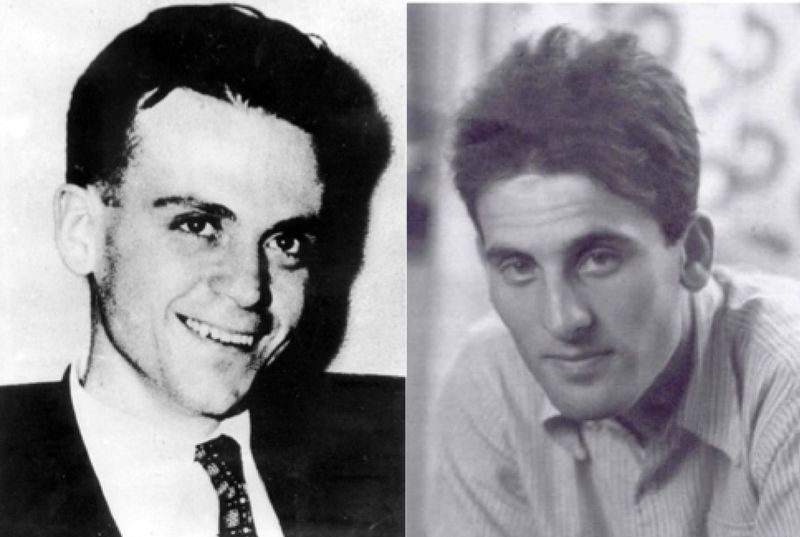
That same year Giuseppe Occhialini arrived in Bristol, an Italian physicist who had worked in São Paulo, and after him his former Brazilian student César Lattes (1924–2005), aged 22. Lattes had been at the University of São Paulo working with a cloud chamber alongside Ugo Camerini and Andrea Wataghin; the exchange of photographs with Occhialini — he sent images from his chamber, Occhialini returned photomicrographs of tracks obtained in the new Ilford emulsions — convinced him that the future lay in the plates, and he asked to join the group.
And there is a third figure the standard accounts tend to leave out: the microscope scanning, plate by plate and field by field, was done by the laboratory's women microscopists. Marietta Kurz was the one who found, on the Pic du Midi plates, the first event in which a meson comes to rest and, at its stopping point, the particle produced by the meson’s decay is born.
Editorial note. The contribution of the Bristol microscopists (Marietta Kurz, Irene Roberts) should appear by name. Contemporary readings of the episode value this point, and it strengthens the human story of the discovery.
Pic du Midi: the hint
In 1946 Occhialini exposed the first new plates at the observatory on the Pic du Midi de Bigorre, in the French Pyrenees, at about 2,900 metres, for roughly six weeks. When they were developed and scanned, two events of the kind being sought appeared: a track that comes to rest and, from that same point, a second meson track running a few hundred microns before stopping in its turn.
Two events are a hint, not a proof. With two cases you cannot measure a mass ratio or rule out coincidence. The result was published in Nature on 24 May 1947 — Lattes, Muirhead, Occhialini and Powell, "Processes involving charged mesons" — and left the group with a very concrete need: more altitude and longer exposure.
The cosmic-ray flux rises steeply with altitude. They had to go higher.
How the mountain was found
Lattes went to the Geography Department of the University of Bristol to search maps and yearbooks for inhabited stations at high altitude. There he found a reference to a weather station in the Bolivian Andes, at some 5,200 metres, founded in 1942 by the Spanish meteorologist Ismael Escobar Vallejo, a refugee of the Spanish Civil War: Chacaltaya.
The lead was probably reinforced by two Spanish meteorologists also in exile and well connected to British physics — Mariano Doporto, director of the Irish Meteorological Service, and Antonio Duperier, a collaborator of Patrick Blackett in London — who knew both the mountain and Escobar.
The advantages of the site were extraordinary, and still are:
- Altitude. At 5,200 m the site sits above roughly half the atmospheric mass; the particle flux of the cosmic cascade is far greater than at 2,900 m.
- Latitude. It lies practically on the geomagnetic equator, where the cut-off rigidity is highest: a unique condition for comparing results with northern-hemisphere stations.
- Accessibility. It is some 30 km from La Paz, with a road and a hut already built — that of the Bolivian Andean Club, put up around 1940 as a ski refuge — and a working weather station. No other mountain of that height in the world offered that combination.
Lattes's proposal to Powell and Occhialini was straightforward: he would take a batch of boron-treated plates himself and expose them on Chacaltaya for a month.
The journey
Lattes left Bristol with the plates and, in his own words, "a bundle of one-pound notes" barely sufficient to reach Rio de Janeiro and return. He travelled on his holidays and essentially at his own expense; the British government covered part of the mission.
One detail he always recounted: he chose to fly on a Brazilian aircraft rather than the British one he had been booked on. The British aeroplane crashed in Dakar and all its passengers were killed.
In La Paz he developed one plate to check the procedure. The available water was unsuitable and the emulsion came out stained. Even so, that single defective plate already contained one complete double meson, the secondary having a range of about 600 microns. The remaining emulsions travelled back to Bristol undeveloped.
Suggested pull quote: "I could take charge of exposing boron-treated plates on Monte Chacaltaya during a month."
César Lattes, his own account of the discovery.
The result
Developed and scanned in Bristol, the Chacaltaya plates — about 100 µm thick, exposed for roughly forty days — yielded some thirty double-meson tracks. With that harvest, real physics became possible.
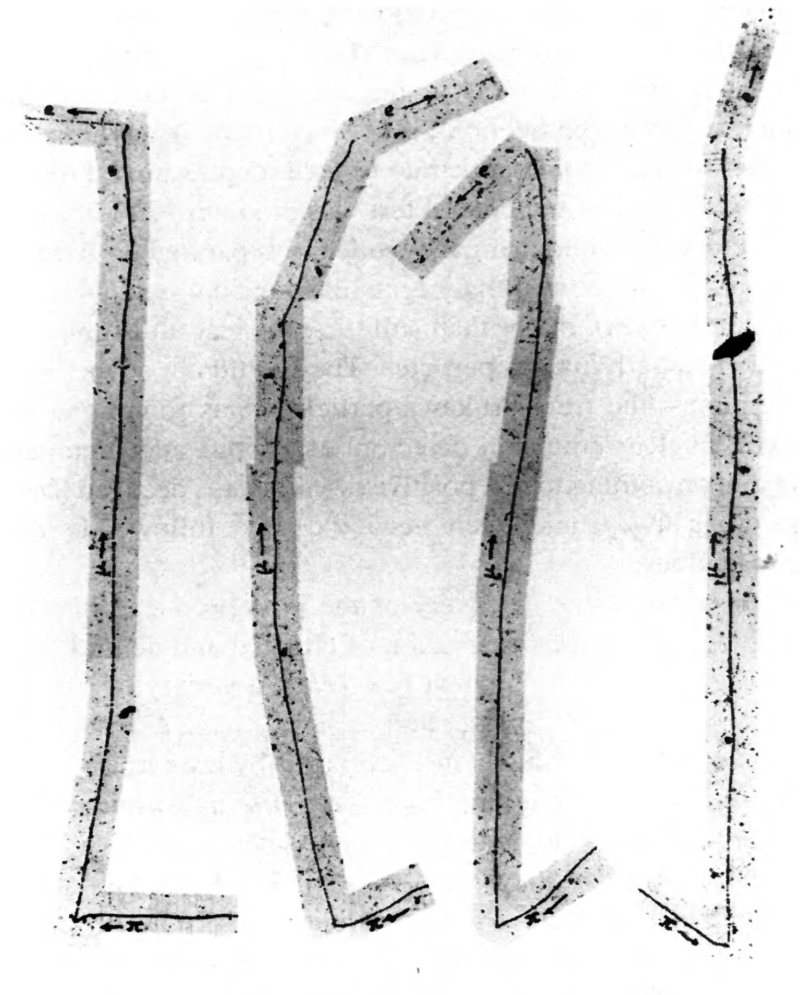
The method was grain counting: in an emulsion, the density of developed grains along a track depends on the ionisation and therefore on the mass and velocity of the particle. By repeatedly counting grains along the primary and the secondary in the longest, best-defined tracks, the group established that the primary particle was heavier than the secondary, with a mass ratio around m₁/m₂ ≈ 2 (values of 2.0 and 1.8 in the two best events; a firm lower limit of 1.5).
The conclusion was unambiguous. It was not one particle: it was two.
- The primary, heavier, interacts strongly with nuclei and decays: it is the particle predicted by Yukawa. It was named the π meson (pion).
- The secondary, lighter and penetrating, is the one Anderson and Neddermeyer had observed in 1937: the μ meson (muon) — which, as would later become clear, is not a meson at all but a lepton, a heavy cousin of the electron.
The observed process is the decay π → μ + ν. The Conversi–Pancini–Piccioni contradiction was resolved: Yukawa was right, and what had been observed for a decade was the decay product of his particle, not his particle.
October 1947
The result was published in Nature, in two consecutive instalments, signed by C. M. G. Lattes, G. P. S. Occhialini and C. F. Powell:
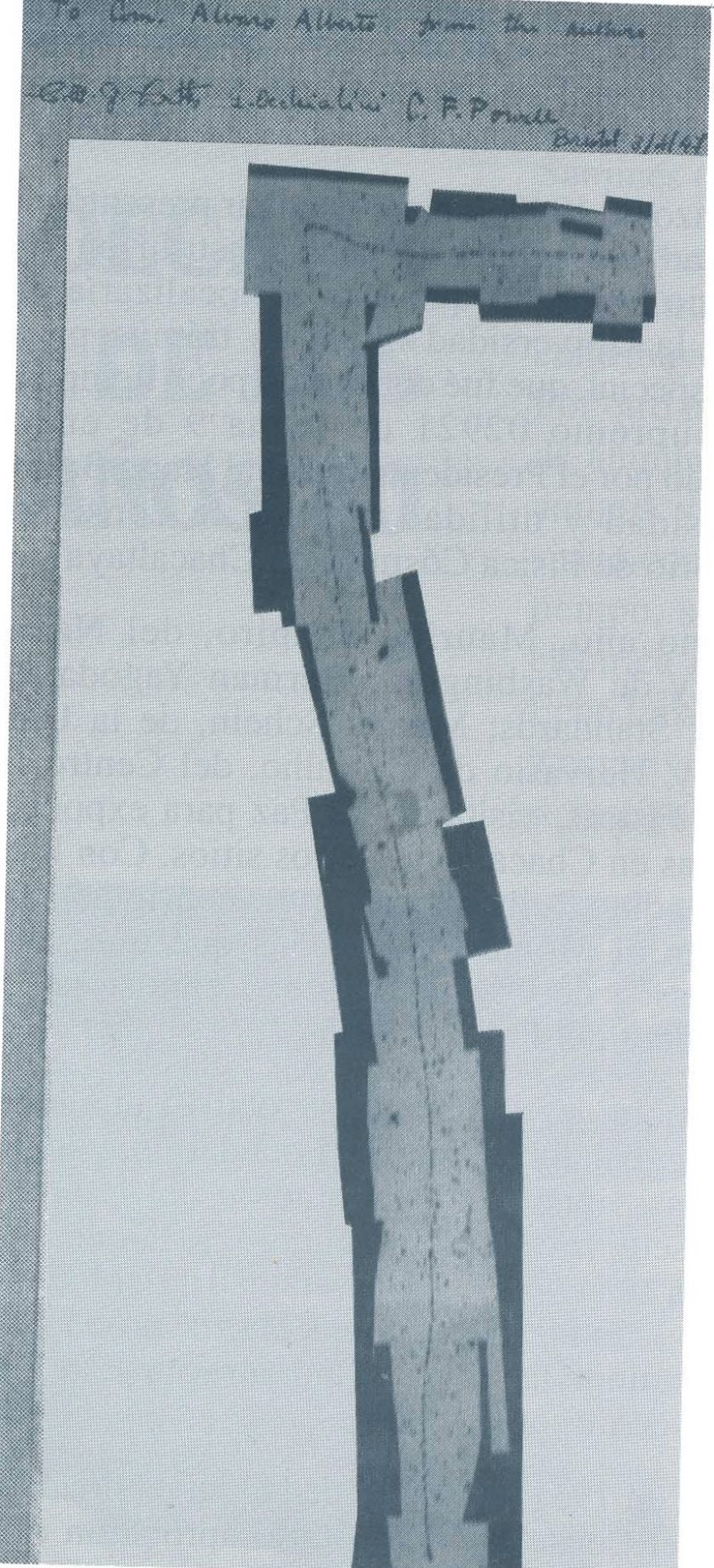
"Observations on the Tracks of Slow Mesons in Photographic Emulsions" Nature 160, 453–456 (4 October 1947) and 486–492 (11 October 1947).
The paper reports "forty examples of the process leading to the production of secondary mesons" and expressly states the origin of the material: plates exposed in the Bolivian Andes at a height of 5,500 m.
That line is the mountain's founding document. In October 1947 the word "Chacaltaya" enters the world scientific literature.
Precision note for the dossier. The Nature paper records 5,500 m; the actual altitude of the installations is 5,200 m and that of the summit 5,600 m. The discrepancy is common in the literature of the period and is better explained on the site than silently corrected.
What followed
The discovery did not close a story: it opened four.
Berkeley, 1948. In early 1948 Lattes arrived at the Radiation Laboratory of the University of California, directed by Ernest Lawrence, where the 184-inch synchrocyclotron had been running for more than a year without anyone managing to detect the mesons the machine had been built to produce. Ten days after his arrival, Lattes recognised the pion tracks in the emulsions: the machine had been producing them since day one, only nobody knew how to identify them. Eugene Gardner and Lattes published the result in Science on 12 March 1948. These were the first pions ever produced artificially by human beings, and the evidence Lawrence needed to secure funding for the Bevatron. What the mountain had found, the machine could now manufacture: this is the precise moment when particle physics begins to move from cosmic rays to accelerators.
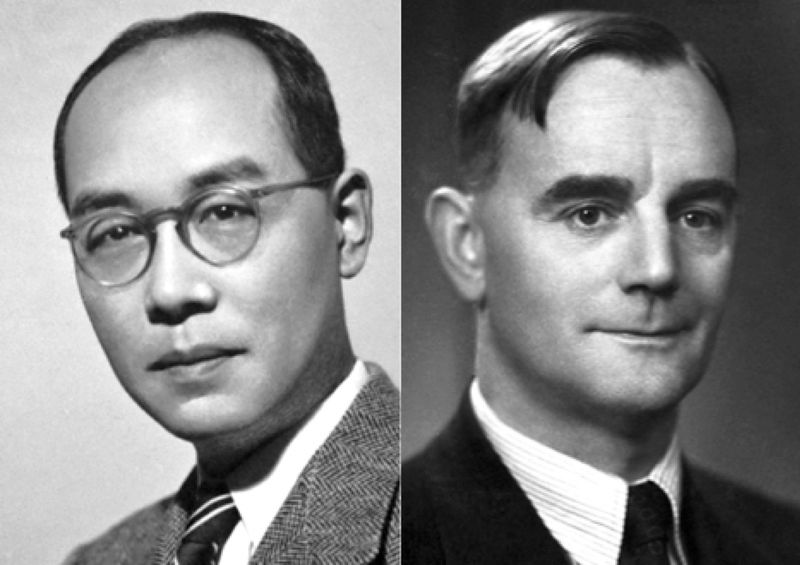
Stockholm, 1949 and 1950. Hideki Yukawa received the 1949 Nobel Prize in Physics "for his prediction of the existence of mesons on the basis of theoretical work on nuclear forces". Cecil Powell received it in 1950 "for his development of the photographic method of studying nuclear processes and his discoveries regarding mesons made with this method". Both citations describe, without naming it, a result obtained with plates exposed on Chacaltaya. Recent historical research also documents seven Nobel nominations for Lattes himself between 1949 and 1954.
Rio de Janeiro, January 1949. The prestige of the finding was used in Brazil as the argument for creating a body devoted exclusively to research in physics: the Centro Brasileiro de Pesquisas Físicas (CBPF) was born, a private institution founded outside the university, with Lattes as scientific director at the age of 24. Two years later came the CNPq (1951). It is an uncommon causal chain in the history of science: evidence obtained on a Bolivian mountain founded two of the parent institutions of Brazilian science.
Chacaltaya, 1952. On returning from the United States, Lattes devoted himself to building a permanent high-altitude laboratory. The choice was obvious. With financial support from UNESCO and the newly created CNPq he brought Occhialini and Camerini to Brazil, and in 1952 the agreement with the Universidad Mayor de San Andrés was signed, giving rise to the Chacaltaya Cosmic Ray Laboratory. In parallel, UMSA had been processing Escobar's draft proposal since 1949, and on 9 January 1952 Supreme Decree 02921 declared the construction of the observatory to be of public necessity and utility.
The site of the discovery became an institution.
Chronology of the milestone
| Date | Event |
|---|---|
| 1935 | Yukawa predicts a particle mediating the strong nuclear force. |
| 1937 | Anderson–Neddermeyer and Street–Stevenson detect a particle of intermediate mass in cosmic rays; it is mistaken for Yukawa's. |
| Sept 1942 | Ismael Escobar installs the Chacaltaya weather station at 5,200 m. |
| 1946 | Conversi, Pancini and Piccioni show that the 1937 particle is not Yukawa's. |
| 1946 | Ilford supplies the Bristol group with the new nuclear emulsions. Lattes arrives in Bristol. |
| 1946 | Occhialini exposes plates for six weeks at the Pic du Midi (2,900 m). Marietta Kurz identifies the first double meson. |
| 24 May 1947 | Nature 159, 694: "Processes involving charged mesons" (Lattes, Muirhead, Occhialini, Powell). Two events. |
| 1947 (first half) ⚠ | Lattes travels to Bolivia and exposes the plates on Chacaltaya, ~40 days. |
| 1947 | Scanning in Bristol: ~30 double mesons. Grain counting: mass ratio ≈ 2. |
| 4 & 11 Oct 1947 | Nature 160, 453 and 486: "Observations on the tracks of slow mesons in photographic emulsions". Chacaltaya enters the world literature. |
| Feb 1948 | Lattes identifies pions produced in the Berkeley synchrocyclotron. |
| 12 Mar 1948 | Gardner and Lattes, Science 109, 270: first artificial pions. |
| Jan 1949 | The CBPF is founded in Rio de Janeiro; Lattes scientific director at 24. |
| 1949 | Nobel Prize in Physics to Hideki Yukawa. |
| 1950 | Nobel Prize in Physics to Cecil Frank Powell. |
⚠ Open dating point. Carlos Aguirre Bastos places Lattes's journey in 1946; Vieira and Videira in the first half of 1947; Lattes himself dates to 1946 the moment when he proposes the expedition. The internal sequence — Pic du Midi plates published in May 1947, Chacaltaya results published in October 1947 — is compatible with an exposure carried out between late 1946 and the first half of 1947. For the UNESCO dossier this should be settled with primary documentation (passports, Bristol–La Paz correspondence, Bolivian Andean Club records, the La Paz press of 1946–1947, the Meteorological Service archive).
People of this milestone
- César Lattes (Curitiba 1924 – Campinas 2005). Brazilian physicist. Exposed the plates on Chacaltaya and measured the mass ratio. Discoverer of artificial pions at Berkeley. First scientific director of the CBPF at 24. Driving force behind the Laboratory and the Brazil–Japan Collaboration.
- Cecil Frank Powell (1903–1969). Head of the Bristol group. Nobel Prize in Physics 1950 for the development of the photographic method.
- Giuseppe "Beppo" Occhialini (1907–1993). Italian physicist, Lattes's professor in São Paulo. Co-discoverer of the pion. Exposed the Pic du Midi plates.
- Hideki Yukawa (1907–1981). Predicted the particle in 1935. Nobel 1949. In 1959 he would write the letter to Lattes that brought Japanese physics to Chacaltaya.
- Ismael Escobar Vallejo (1918–2009). Spanish schoolteacher and meteorologist in exile. Founded the Chacaltaya station in 1942 and would become the Laboratory's first director.
- Marietta Kurz. Microscopist at the Bristol laboratory. Identified the first double-meson event on the Pic du Midi plates.
- Eugene Gardner (1913–1950). Head of the Nuclear Emulsion Division at Berkeley; co-author of the discovery of artificial pions.
Glossary (collapsible block on the page)
- Cosmic ray. A very high-energy atomic nucleus of space origin. On striking the atmosphere it generates a cascade of secondary particles.
- Nuclear emulsion. A thick, highly sensitive gelatine plate loaded with silver halide, in which the passage of a charged particle is recorded, after development, as a row of grains visible under a microscope.
- Meson. A particle of mass intermediate between the electron and the proton. The pion is one; the muon, despite its historical name, is not.
- Pion (π meson). The carrier of the strong nuclear force, predicted by Yukawa in 1935 and experimentally established in 1947.
- Muon (μ meson). A heavy lepton, the decay product of the pion. It is the penetrating component that reaches the ground.
- Grain counting. A measurement technique: counting the developed grains per unit length along a track allows the particle's mass to be estimated.
- Geomagnetic cut-off rigidity. The minimum energy a charged particle needs to penetrate the Earth's magnetic field at a given point. It is highest at the geomagnetic equator, where Chacaltaya lies.
The case for the UNESCO nomination
Short form (for the page):
The Pyrenees gave the hint; Chacaltaya gave the proof. The first two events were captured at the Pic du Midi; the thirty that made measurement and conclusion possible were captured here. Two Nobel Prizes in Physics — 1949 and 1950 — rest on plates exposed on this mountain, and from that evidence came the CBPF, the CNPq and, in 1952, the Laboratory itself.
Developed form (for the dossier):
- Precedence and sufficiency of the evidence. The Nature 160 papers (4 and 11 October 1947) expressly identify the material analysed as plates exposed in the Bolivian Andes at high altitude, and it is that sample — not the Pic du Midi one — which permits the measurement of the mass ratio and, with it, the conclusion that two distinct mesons exist.
- Transnational institutional consequence. From the prestige of that result came the CBPF (January 1949) and, in its wake, the CNPq (1951) in Brazil, and the Chacaltaya Cosmic Ray Laboratory (1952) in Bolivia. It is an unusual case of a geographical site giving rise to national scientific institutions in two countries. It grounds a joint Bolivia–Brazil dossier.
- Continuity of scientific use. The site of the discovery is not a commemorative ruin: it is still operating in 2026, with the WMO's GAW/CHC station and the ALPACA/ALPAQUITA experiment. The integrity and authenticity of the property rest on eighty years of uninterrupted use.
Sources
- C. M. G. Lattes, G. P. S. Occhialini and C. F. Powell, "Observations on the Tracks of Slow Mesons in Photographic Emulsions", Nature 160, 453–456 (4 October 1947) and 486–492 (11 October 1947). DOI: 10.1038/160453a0
- C. M. G. Lattes, H. Muirhead, G. P. S. Occhialini and C. F. Powell, "Processes Involving Charged Mesons", Nature 159, 694–697 (24 May 1947). DOI: 10.1038/159694a0
- E. Gardner and C. M. G. Lattes, Science 109, 270 (1948).
- Carlos Aguirre Bastos, Medio siglo de ciencia en Bolivia. El Laboratorio de Física Cósmica de Chacaltaya de la Universidad Mayor de San Andrés, Fundación Universitaria Simón I. Patiño, La Paz, May 1996, ch. III.
- Cássio Leite Vieira (CBPF) and Antonio Augusto Passos Videira (UERJ), "Chacaltaya: um laboratório nas nuvens", in História da Física (2019), pp. 129–141. Earlier version in Scientific American Brasil, January 2015.
- Luca Gariboldi, "Lattes' contribution to the discovery of the π meson in Bristol", SISFA.
- César Lattes's autobiographical account of the discovery, Grupo de História da Ciência e Ensino, USP.
- A. Marques de Oliveira, "25 Anos da Descoberta do Meson pi", CBPF, Ciência e Sociedade 12, Rio de Janeiro, 1973.
- The Nobel Foundation, citations for the Physics Prizes of 1949 (Yukawa) and 1950 (Powell).
This site is being built
The Chacaltaya Cosmic Ray Laboratory is a candidate for World Heritage status. If you hold documents, photographs or memories of the Laboratory, the project would like to hear from you.
Get in touch