
Five years after photographic plates exposed on this mountain changed particle physics, Chacaltaya was still nothing more than a mountain with a weather station on it. Turning it into an institution took three years and three signatures: a university's, a state's and a neighbouring country's. Not one of the three is superfluous, and all three survive.
1949: the draft proposal
In early 1949, with the discovery of the pi meson still recent, Ismael Escobar presented the Rector of the Universidad Mayor de San Andrés with a proposal to build a permanent observatory on Chacaltaya. This was no after-dinner notion: he published it as "Anteproyecto para el Observatorio de Física Cósmica Chacaltaya" ("Draft proposal for the Chacaltaya Cosmic Physics Observatory") in the journal Nimbus, the scientific organ of the Meteorological Service he himself directed.
The reasoning was what the mountain had been demonstrating since 1947. Expeditions arrived, exposed their plates and left. What was missing was a permanent institution to serve as a base for the international scientific community — that is, ceasing to be a place one visits and becoming a place where one works.
The permit, and an administrative paradox
Chacaltaya had lain inside a National Park since 1942, and article 5 of that decree required a special permit to erect any building. The University began the process.
Here Aguirre Bastos records, in a footnote, a detail best not concealed:
The permit was obtained "practically by Escobar himself, since he worked at the Ministry of Agriculture, the institution responsible for granting such permits" (translated from the Spanish).
The man who wanted to build the observatory worked at the ministry that had to authorise it. Put another way: the same person who installed the weather station in 1942, who founded the Meteorological Service, who published the draft proposal and who would become the Laboratory's first director was also the one who signed — from the other side of the desk — the authorisation to build it.
The site should tell this, not omit it. In a country with a scientific community of two dozen people, the concentration of roles is not corruption: it is scarcity. And telling it frankly strengthens the credibility of the rest of the dossier.
📄 The document exists. In his book, Carlos Aguirre Bastos reproduces the note from the Minister of Agriculture to the Rector of the University, dated 11 January 1952, announcing the authorisation to build the Laboratory at Chacaltaya. It is the piece that closes the documentary chain opened by the 1942 decree.
1951: the University creates the Laboratory
Later, in 1951, the Rector and the University Council of UMSA officially approved the creation of the Chacaltaya Cosmic Ray Laboratory, defined as a
"centre for research, teaching and meteorological observations" (translated from the Spanish)
to be operated partly by the University and partly by the Meteorological Service of Bolivia.
That three-legged definition — research, teaching and weather observation — matters more than it seems. It is what explains how the same site produced, over the following forty years, particle physics, 120 theses and unbroken atmospheric series.
Aguirre names the authorities who made it possible: Rector Claudio Sanjinés and professors Vicente Burgaleta (Dean of Engineering until his death in 1952), Jorge Muñoz Reyes and Hugo Mansilla Romero, who would succeed Burgaleta as dean. Several of them would become rectors in later years. And he adds, honestly, that there were also many detractors.
9 January 1952: the supreme decree
Supreme Decree 02921, of 9 January 1952, promulgated by President General Hugo Ballivián, declared the
"construction of a Cosmic Physics Observatory at Chacaltaya to be of public necessity and utility" (translated from the Spanish).
Two days later, on 11 January, the Minister of Agriculture informed the Rector of the authorisation to build inside the National Park. The administrative sequence was closed in under a week.
January–August 1952: the mountain is built
The Laboratory's official activities begin on 19 January 1952, with Ismael Escobar as its first director. ⚠ (See open points: other versions give 1 January.)
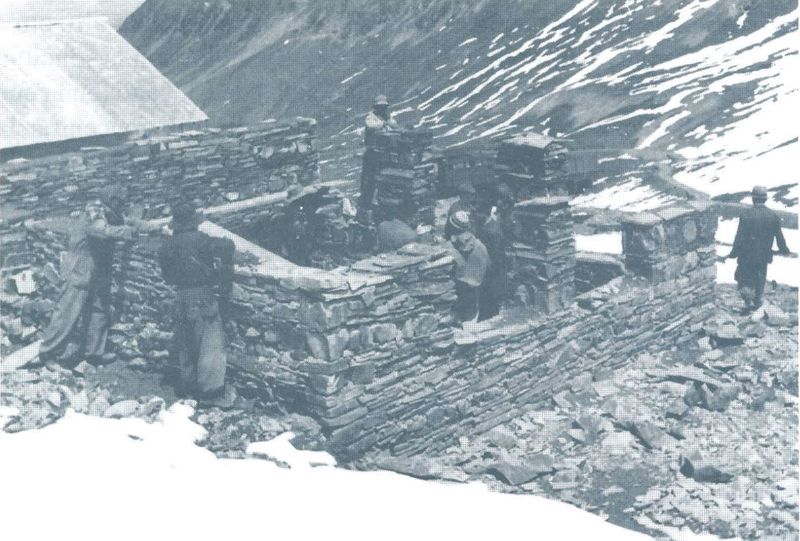
What follows reads as a chronicle of precariousness and determination:
- 18 January. Memorandum no. 12/18240/23316 from Rector Sanjinés.
- 21 January. The University authorises the construction of a wooden cabin at Chacaltaya and contributes 5,510 feet of timber (Official letter no. 12-1842-23330 from Rector Sanjinés).
- 3 March. Escobar obtains a small aluminium house free of charge. It is carried up the mountain by students, friends and members of the Club Andino Boliviano (Bolivian Andean Club). It was the scientists' first shelter.
- A diesel engine is coupled up to supply electricity to the equipment — the same equipment that had been tested at the Echo Lake Laboratory in Colorado — intended to study the asymmetry of positive and negative mesons at the geomagnetic equator.
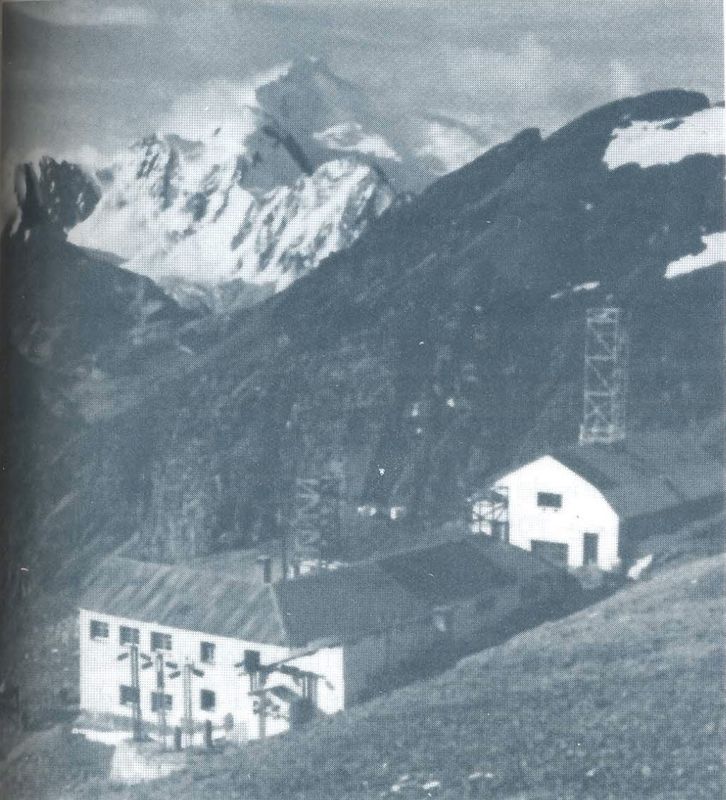
- August 1952. The first building is inaugurated. That same month Rector Sanjinés leaves office; he is succeeded by Pedro Valdivia.
Editorial note. "It was carried up by hand by students, friends and members of the Andean Club" is probably the best sentence in the dossier for explaining what kind of institution this is. It deserves a photograph and a prominent place on the page.
April 1952: a physicist in a basement
Frank Harris arrived in La Paz with his family in April 1952 to become the newly created Laboratory's first official visiting researcher. He arrived just in time to spend several days in the basement of his house while, outside, the National Revolution was unfolding — one of the bloodiest episodes in Bolivia's history.
When he came out, he did his experiment. The result was his doctoral thesis on variations in muon intensity, supervised by Bruno Rossi at MIT — who, by Harris's own account, gave him more than one headache with the meticulousness of his revisions.
That collaboration with MIT was no accident. In September 1950 Escobar had won a fellowship from the John Simon Guggenheim Memorial Foundation and, together with Rossi, began a cooperation that would last close to twenty years. In 1951 he visited the Echo Lake Laboratory of the University of Colorado, where with Harris he tested the equipment that would later go up to Chacaltaya.
The Laboratory was therefore born with its partners already secured. The building was not put up first and users sought afterwards.
December 1952: the agreement with Brazil
Against the background of an already close collaboration, the University charged a commission — the Dean of Social Sciences Luis Ballivián Saracho, the Dean of Exact Sciences Hugo Mansilla and the Director of Exact Sciences Jorge Muñoz Reyes — with examining a draft agreement with the Centro Brasileiro de Pesquisas Físicas.
With a favourable opinion in hand, the Honourable University Council approved its signing. In a note of 3 December 1952, Rector Pedro Valdivia communicated the decision to César Lattes. Immediately afterwards the Collaboration Agreement was signed:
| For the Universidad Mayor de San Andrés | For the Centro Brasileiro de Pesquisas Físicas |
|---|---|
| Pedro Valdivia, Rector | João Alberto Lins de Barros, President |
| Franklin Antezana Paz, Treasurer | César Lattes, Scientific Director |
The agreement brought financial and human resources of the highest quality and, above all, turned the Laboratory into a first-class scientific facility for the study of cosmic rays. Aguirre stresses that it was fundamental not only for Chacaltaya: it was so for the growth of the CBPF itself as well.
The cooperation was still alive as he wrote, forty years later, and was by then one of the oldest in Latin America.
A logistical fact worth a paragraph: until the early 1970s the Correio Aéreo Nacional of the Brazilian Air Force carried personnel and equipment between Rio de Janeiro and La Paz free of charge. The continent's most enduring scientific collaboration travelled, for twenty years, on borrowed military aircraft.
And meanwhile, the world was already coming up
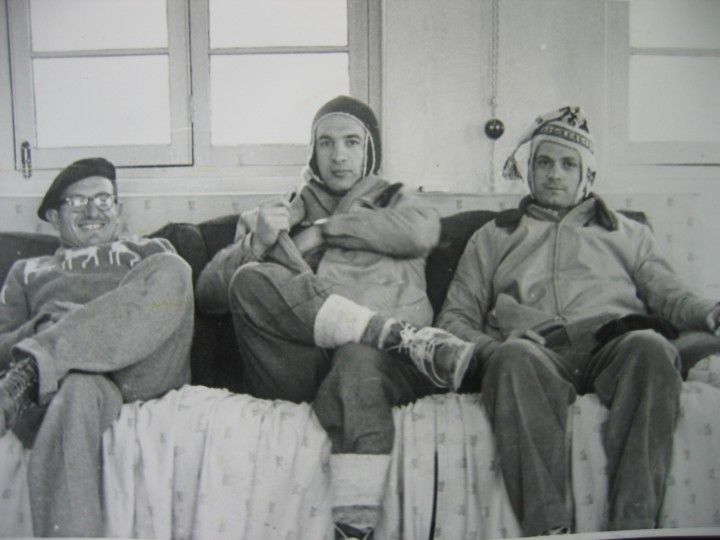
In 1952, even before the agreement was signed, Maurice Shapiro (Naval Research Laboratory, Washington), Herman Yagoda (National Bureau of Standards), Marcel Schein (University of Chicago) and Hervásio de Carvalho (CBPF) arrived in La Paz to expose photographic emulsions at Chacaltaya and other sites.
Two details worth recounting:
- With the collaboration of the Club Andino Boliviano, one group managed to place emulsions on Mount Sajama. They were never able to recover them. Escobar left a record of the episode in Nimbus under a title that speaks for itself: "Una expedición al Sajama" ("An expedition to Sajama").
- De Carvalho placed emulsions at various depths in Lake Titicaca.
The mountain was not yet the only site: it was the one that worked.
Chronology of the milestone
| Date | Event |
|---|---|
| Early 1949 | Escobar presents the draft proposal for the observatory to the Rector and publishes it in Nimbus. |
| 1949 → 1952 | The University processes the special permit required by art. 5 of the 1942 decree. |
| September 1950 | Escobar wins a Guggenheim fellowship; with Bruno Rossi he begins the collaboration with MIT that will last twenty years. |
| 1951 | Escobar visits the Echo Lake Laboratory (University of Colorado) and tests equipment with Frank Harris. |
| 1951 | The Rector and the University Council of UMSA officially create the Chacaltaya Cosmic Ray Laboratory. |
| 9 January 1952 | Supreme Decree 02921 (President Gen. Hugo Ballivián): the construction of the observatory is of public necessity and utility. |
| 11 January 1952 | Note from the Minister of Agriculture to the Rector authorising construction inside the National Park. 📄 Reproduced by Aguirre. |
| 18 January 1952 | Memorandum no. 12/18240/23316 from Rector Sanjinés. |
| 19 January 1952 ⚠ | Official activities begin. Escobar, first director. |
| 21 January 1952 | UMSA authorises the wooden cabin and contributes 5,510 feet of timber. |
| 3 March 1952 | Students, friends and members of the Andean Club carry the aluminium house up by hand, the scientists' first shelter. |
| April 1952 | Frank Harris, the first visiting researcher, arrives in the midst of the National Revolution. |
| August 1952 | The first building is inaugurated. Pedro Valdivia succeeds Claudio Sanjinés as Rector. |
| 1952 | Shapiro, Yagoda, Schein and de Carvalho expose emulsions at Chacaltaya, Sajama and Titicaca. |
| 3 December 1952 | Rector Valdivia informs Lattes of the approval of the agreement. |
| December 1952 | The CBPF–UMSA Collaboration Agreement is signed. |
Open points
⚠ The date activities began. Aguirre's text, read by OCR, says "19 January 1952", which fits the neighbouring dates (memorandum of the 18th, cabin authorisation of the 21st). Other versions of the script have recorded 1 January 1952. Check against the printed page before fixing the date on the site: the difference between "1" and "19" is a typical OCR error and should not be settled by eye.
✅ The decree number — settled. The index of the Gaceta Oficial confirms Supreme Decree 2921, of 9 January 1952, with the official summary line “Observatorio Físico Cósmico.- Se autoriza su instalación en Chacaltaya”. The “02911” in the ministerial note was a misreading. Note the name the State gave it: Observatorio Físico Cósmico. The full text (some 250 words) remains to be obtained. Checked on 19 September 2026 via D-Lex Bolivia.
⚠ The exact date the agreement was signed. Aguirre says "immediately afterwards" the note of 3 December 1952, without giving a day. Locate the signed copy.
⚠ The text of the permit. The note from the Minister to the Rector (11 January 1952) is known because Aguirre reproduces it. What is still missing is the complete file of the process begun in 1949, which would document the procedure and not merely its outcome.
People of this milestone
- Ismael Escobar Vallejo. Author of the draft proposal, obtainer of the permit and first director of the Laboratory (1952–1963).
- Claudio Sanjinés. Rector of UMSA until August 1952. Signed the university acts of creation and construction.
- Pedro Valdivia. Rector from August 1952. Signed the agreement with the CBPF.
- Franklin Antezana Paz. Treasurer of UMSA, co-signatory of the agreement.
- Vicente Burgaleta. Dean of the Faculty of Engineering until his death in 1952.
- Hugo Mansilla Romero. Burgaleta's successor as dean; a former colleague of Escobar's at the Comité Fiscal de Fomento Agrícola (Fiscal Committee for Agricultural Development). Member of the commission that assessed the agreement.
- Jorge Muñoz Reyes. Director of Exact Sciences; member of the same commission.
- Luis Ballivián Saracho. Dean of Social Sciences; third member of the commission.
- César Lattes. Scientific director of the CBPF, co-signatory of the agreement.
- João Alberto Lins de Barros. President of the CBPF, co-signatory.
- Bruno Rossi (1905–1993). Italian physicist at MIT. Escobar's partner from 1950; supervisor of Harris's thesis.
- Frank Harris. The Laboratory's first official visiting researcher, April 1952.
- Hugo Ballivián. President of Bolivia, signatory of Supreme Decree 02921.
The case for the UNESCO nomination
Short form (for the page):
The Laboratory was founded not once but three times: by the University in 1951, by the Bolivian state in January 1952 and by a binational agreement with Brazil in December of the same year. All three acts are dated, named and preserved. And all three took place within the protective regime that has covered the site since 1942.
Developed form (for the dossier):
- Documentary authenticity in three independent registers. A heritage property usually attests its origin with one document. This one has three, of distinct legal character — university, state and binational — plus the ministerial permit that links them to the protective regime of 1942. The probability that all three were altered or reconstructed after the fact is nil, and each one points to a different archive.
- International vocation from the birth certificate onwards. The agreement with the CBPF dates from December 1952, the same year as the founding. The Laboratory did not become international over time: it was born international. The collaboration with MIT is even earlier (1950), and by 1952 researchers from three United States institutions and one Brazilian institution had already come up.
- Reciprocity, not dependence. Aguirre stresses that the agreement was fundamental for the growth of the CBPF itself as well. This is a point worth highlighting before an international committee: the site was not a natural resource exploited from outside, but the basis of a relationship in which both institutions gained. It strengthens the case for a joint Bolivia–Brazil dossier.
- Construction as a collective act. The Laboratory's first shelter went up the mountain in the hands of students, friends and mountaineers. For a dossier claiming cultural as well as scientific value, the communal dimension of the founding is an asset, not an anecdote.
Sources
- Carlos Aguirre Bastos, Medio siglo de ciencia en Bolivia. El Laboratorio de Física Cósmica de Chacaltaya de la Universidad Mayor de San Andrés, Fundación Universitaria Simón I. Patiño, La Paz, 1996, chs. IV and V.
- Ismael Escobar V., "Anteproyecto para el Observatorio de Física Cósmica Chacaltaya", Nimbus, La Paz, 1949.
- Ismael Escobar V., "Una expedición al Sajama", Nimbus, vol. 4, and Revista Meteorológica del Uruguay, Montevideo, 1950.
- Supreme Decree 2921, of 9 January 1952. ✅ Located in the index of the Gaceta Oficial (summary line: “Observatorio Físico Cósmico.- Se autoriza su instalación en Chacaltaya”); full text still to be obtained.
- Note from the Minister of Agriculture to the Rector of UMSA, 11 January 1952. Reproduced in Aguirre (1996).
- Memorandum no. 12/18240/23316 from Rector Claudio Sanjinés, 18 January 1952; Official letter no. 12-1842-23330.
- Note from Rector Pedro Valdivia to César Lattes, 3 December 1952.
- CBPF–UMSA Collaboration Agreement, December 1952.
- Cássio Leite Vieira and Antonio Augusto Passos Videira, "Chacaltaya: um laboratório nas nuvens", in História da Física (2019).
This site is being built
The Chacaltaya Cosmic Ray Laboratory is a candidate for World Heritage status. If you hold documents, photographs or memories of the Laboratory, the project would like to hear from you.
Get in touch