Fifty-four years of the same experiment on the same site
Milestones 06
Fifty-four years. The same experiment, on the same site, from the first detectors of 1961 to the shutdown in 2015. In that time BASJE gave the first evidence that cosmic rays of the highest energies begin to escape from the galaxy, measured a nuclear quantity before the accelerators could verify it, and took the pioneering steps of a discipline that today has observatories on four continents.
What it set out to find
The Bolivian Air Shower Joint Experiment was born with three objectives, stated with precision from the outset:
To search for showers generated by primary gamma rays with energies above 10¹⁴ eV.
To search for evidence of primary cosmic rays of high atomic number.
To study the characteristics of super-high-energy nuclear interactions, above 10¹⁴ eV.
Seen from today, the first of those three objectives is the birth certificate of a discipline: very-high-energy gamma-ray astronomy. In 1960 nobody knew whether there was anything there to observe.
Who built it
Four institutions and four names:
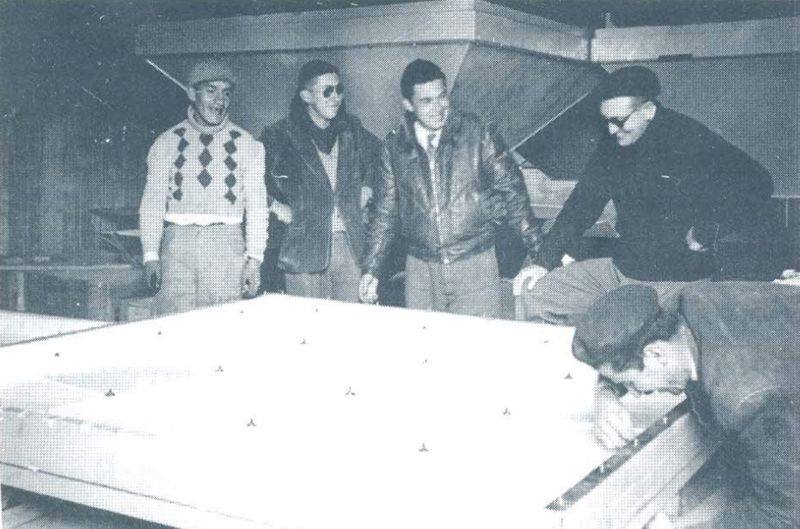
The start of construction of the BASJE muon detector. IIF–UMSA archive · reproduced in Aguirre (1996).
Institution
Lead
Massachusetts Institute of Technology
George Clark
University of Tokyo
Koichi Suga
Institute of Physical and Chemical Research (IPCR), Japan
Kazuaki Murakami
Chacaltaya Cosmic Ray Laboratory
Ismael Escobar
Aguirre reproduces a photograph with a spare caption: "The three figures of BASJE: Ismael Escobar, Bruno Rossi and Koichi Suga." (translated from the Spanish)
And about Suga he writes something the site should carry as it stands:
Koichi Suga was the soul of BASJE for thirty years. His broad command of the subject and his enormous capacity for work were fundamental factors in the scientific success of this cooperative project. He died in Tokyo while analysing the Chacaltaya data.
The Bolivian team
In the first stage: Ángel García, Ramón Schulczewski, José Ipiña, Alfonso Lazo, Israel Saravia, Ricardo Anda, Eduardo Maldonado and Carlos Uria.
Later on: Julio Pacheco, José Rivas, Abelardo García, Elsa Maceda, Iván Geir, Carlos Ormachea, Honorio Vargas, Dardo Beramendi and many others.
Editorial note. Several of these names appear in the photographs of the Carlos Ormachea archive. This is the most direct crossing point between the project's photographic collection and a scientific milestone, and it is worth exploiting: they are the same people.
⚠ Aguirre writes "Dardo Beramendi"; the photographic archives say "Dardo Veramendi". The spelling must be settled.
The Japanese team
Yoshio Toyoda, Koichi Kamata, Shinkishi Shibata, Tatsunosuke Kaneko, Hisashi Yoshii, Motonobu Nagano, together with technicians and graduate students: Hiromitsu Akiyama, Kenji Uchino, Toshiro Maeda, Motonobu Takano, Chiaki Yokoyama, H. Nakatani, M. Kakimoto, Serge Jadot, François Siohan.
On the United States side, one important figure: Hale Bradt.
Sixty square metres under lead
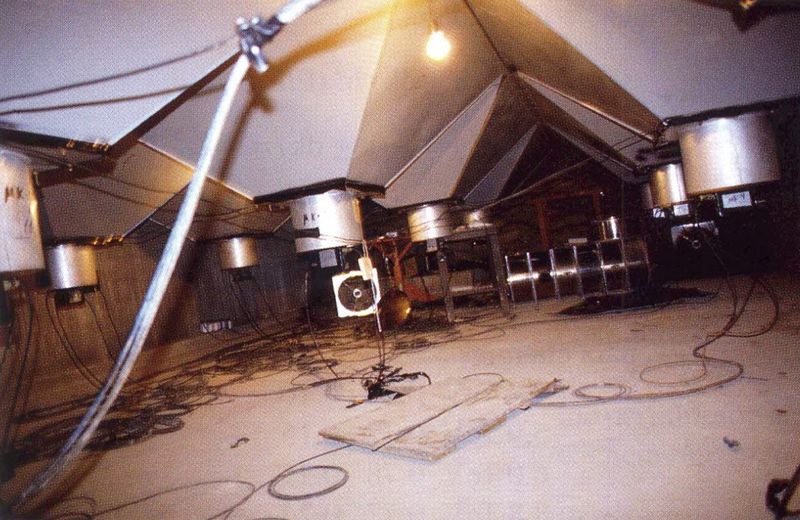
The centrepiece was a 60 m² muon detector: fifteen detectors of four square metres each, under a shield of galena — lead ore — and concrete of about 320 g/cm² — 165 g/cm² of galena in a layer some 60 cm thick, with a 2 cm sheet of lead on top — resting on a reinforced-concrete structure. The shield stops the shower's electrons and photons; only muons above 500 MeV get through. That is how its builders described it to the Pontifical Academy of Sciences in 1962 (source 2).
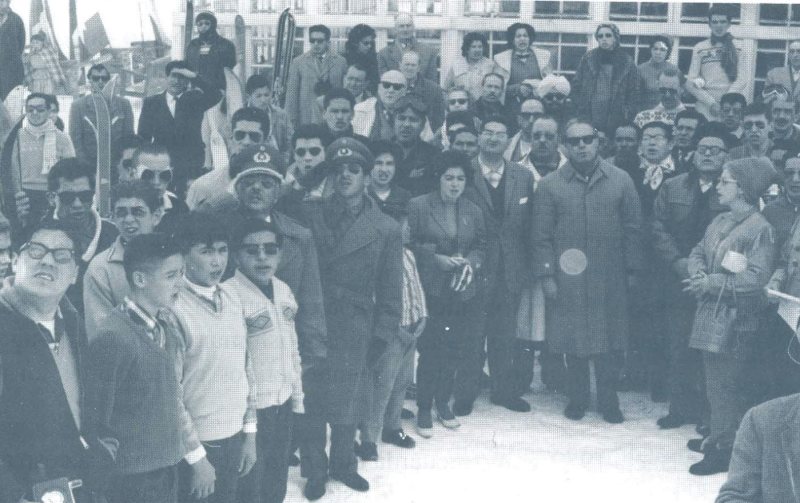
President Víctor Paz Estenssoro’s visit to the Laboratory, according to the archive, c. 1960–1964. His government donated the BASJE lead ore by decree in January 1962. IIF–UMSA archive · reproduced in Aguirre (1996).The completed muon detector, beneath its shield of galena and concrete; the lead ore was donated by the State. IIF–UMSA archive · reproduced in Aguirre (1996).
⚠ The OCR transcription of that footnote is damaged: a quantity ("400") and a figure in dollars (5,849.70) appear which cannot be read with confidence. The note must be checked against the printed page and the decree located. It is the third instrument of state in the dossier, after that of 1942 and Supreme Decree 02921 of 1952.
More than sixty tonnes of equipment arrived from Japan and the United States through the ports of Arica and Mollendo. In early 1961 the first electron-density detectors were installed at previously selected points on the mountain. A group of five was assigned to measuring the differences in particle arrival times, in order to obtain the arrival direction of the primary.
And one difficulty that sums up the whole site: protecting the detectors from a thermal swing that on Chacaltaya reaches 20 degrees in a single day, about a mean temperature of 5 degrees.
1963: the first results
BASJE took data from January 1962, and at the 1962 study week of the Pontifical Academy of Sciences in Vatican City, Clark, Escobar, Murakami and Suga presented the results of the first six months (source 2): the showers observed at 5,200 m are near their maximum development; the fluctuations in muon number are three times smaller than at sea level; there is an indication of a "knee" in the size spectrum between 2 × 10⁵ and 5 × 10⁵ particles; and there is a group of showers with an extraordinarily small proportion of muons — about 3 × 10⁻⁴ of ordinary showers above 10¹⁵ eV — which may be the offspring of primary gamma rays. The first results were published in 1963.
The result that is still a reference
BASJE's major contribution in its first stage was the determination of the energy spectrum of primary cosmic rays between 8×10¹⁴ and 4×10¹⁷ eV.
And within that spectrum, one concrete finding: the exponent of the power law changes from −1.8 to −2.2. What that means, put without formulas: above a certain energy cosmic rays cease to be confined by the magnetic field of the Milky Way and begin to escape from the galaxy. It was the first time this had been shown.
Aguirre puts it this way: although the exact size of the change in exponent is debated,
"there is no doubt that the observation made by BASJE is a point of reference for all the studies of cosmic rays carried out in the world today".
And he adds the second legacy: in that same period, BASJE took the pioneering steps towards establishing the new science of gamma-ray astronomy.
1969–1975: ahead of the accelerators
The original apparatus operated essentially unmodified until 1969, when a new experiment began: measuring the energy spectrum of the surviving primary protons at the altitude of Chacaltaya.
That experiment was the first to show the energy dependence of the collision cross-section, between 3.4 and 8.8 TeV, before the artificial accelerators could verify it in that range.
The measured values of the ratio between the neutron flux and the proton flux:
Energy
J_n / J_p
≥ 3.4 TeV
0.59 ± 0.08
4.4 TeV
0.58 ± 0.10
5.9 TeV
0.72 ± 0.15
6.0 TeV
0.78 ± 0.21
8.8 TeV
0.77 ± 0.24
It was published in Il Nuovo Cimento in June 1975. In 1972 the experiment was brought to a close and work began on enlarging the apparatus to detect large showers over a wider area, with the aim of establishing the primary spectrum above 10¹⁵ eV, determining the chemical composition of the radiation and exploring nuclear interactions at those energies.
Who else came up
BASJE attracted other institutions and other instruments:
The University of Michigan installed a 60-inch cloud chamber above the muon detector, and Cherenkov radiation detectors with it. Principal investigators: Wayne Hazen, Alfredo Hendel, Paul Barker, Brian Rennex; for MIT, George Clark, Hale Bradt and Allan Krieger.
Experiments were carried out with spark chambers to measure the fine structure of the cores of electromagnetic cascades.
The Michigan group, led by Howard Smith, explored the detection of radio pulses emitted by the showers, distinguishing them from pulses caused by atmospheric electric fields.
In the late 1960s MIT left the project and the University of Maryland came in, with Martin la Pointe, Gourang Yodh and Howard Laster. Their participation ended in the early 1970s.
From then on, BASJE was strictly a cooperative project between Bolivia and Japan. And it went on measuring for another forty years.
Paul Barker was also a distinguished ornithologist. He died as a result of an accident on Mount Illimani.
The one who turned back
In June 1965 Dr Charles Forline arrived in La Paz. He was met at the airport and dropped at his hotel. And he vanished completely.
Several days later a note of apology arrived: he had not been feeling well, he had developed a horrible fear of the altitude, and he had gone back to the United States on the first available flight.
He was replaced by Dr John Gaebler, who also stayed only a short time.
Editorial note. Telling this is not a joke at Forline's expense: it is the most economical way of explaining what 5,200 metres means. The site should include it, respectfully, alongside the 20-degree daily temperature swing and the sixty tonnes of equipment hauled up from the port. The physical difficulty of the site is part of its value.
January 1972, in Kyoto
An episode that closes a circle. In January 1972, during a year-long stay in Japan, Carlos Aguirre presented his work on the neutron-to-proton ratio at very high energies in a seminar at the Research Institute for Fundamental Physics of Kyoto University. Among the audience was Hideki Yukawa.
They talked. And Yukawa, according to Aguirre, recalled with fondness his decisive part in launching the Brazil–Japan project, and the discovery of the pi–mu decay at Chacaltaya, which had won him the Nobel Prize in Physics.
Twenty-five years after Lattes's plates, the man who had predicted the particle was speaking about that mountain with a Bolivian physicist who worked on it.
1973 · SYS and Turin: when the mountain's two techniques came together
Twelve years after BASJE's first detectors, in 1973, two new groups were installed at Chacaltaya. They arrived the same year, with the same object of study, and neither of them left soon.
The first, from Saitama University, led by Professor Tsuneo Matano, to study small air showers — of the order of 10¹⁴ eV ⚠. This is the experiment that the international literature identifies by the acronym SYS: Saitama · Yamanashi · San Andrés (§10.6).
The second, from the University of Turin, led by Professor Giani Navarra, to study the time variations of those same small showers.
10.1 · SYS did not duplicate BASJE: it shared out the work
BASJE aimed at the high end of the spectrum — between 8×10¹⁴ and 4×10¹⁷ eV. SYS was created for the band of small showers. They are contiguous bands of the same spectrum, measured on the same site and in the same years. From 1973 onwards the mountain covered a far wider energy range than either experiment on its own.
10.2 · The hybrid instrument
This is the point that matters. For thirty years the Laboratory housed two instrumental traditions running in parallel without touching:
The emulsion chamber of the Brazil–Japan Collaboration, from 1962: the "sandwich" of lead, X-ray film and nuclear emulsion. It sees the nuclear interaction in extraordinary detail, but it does not see the whole shower.
The surface array of BASJE, from 1961: scintillators and a muon detector. It sees the whole shower and its geometry, but it does not see the detail of the interaction.
In the 1980s, SYS brought them together in a single apparatus. Aguirre describes it as "a combined set-up of nuclear emulsions and a shower detector", devoted to the study of high-energy gamma rays ⚠ and to the structure of the cascades inside extensive air showers. The later literature calls that configuration, by that name, a hybrid experiment: "Hybrid experiments operating simultaneously an air-shower array, a hadron calorimeter and an emulsion chamber have been carried out at Mt. Chacaltaya (5200 m, Bolivia)".
Why this belongs in the dossier. The Laboratory did not merely host two foreign programmes in parallel for three decades: it produced a third that fused their two techniques. That is the difference between a hospitable site and a centre with instrumental development of its own.
10.3 · The gamma-ray line, with no gap
The SYS programme in the 1980s and 1990s searched for diffuse high-energy gamma-ray emission using hadron-poor showers — the direct echo of the muon-poor showers method with which BASJE had opened the search in 1961. It swept eight X-ray sources — Vela X-1, Sco X-1, SS433, X1822-37, V1223 Sgr, X1700-37, X1907+097, AE Aqr — and the galactic centre, with both steady-emission and phase analyses.
All the results were negative. As of the date of Aguirre's book, no special concentration had been detected in any of those directions. It is worth publishing it that way: a site that declares its negative results is more credible than one that only lists its successes.
With SYS, the line of gamma-ray astronomy at Chacaltaya is continuous over sixty years:
BASJE (1961) — muon-poor showers ↓SYS (1980s–1990s) — hadron-poor showers; eight sources and the galactic centre ↓OMEGA (1989) — the proposal that set the ambition ↓ALPACA (today) — the southern sky above 100 TeV
Without SYS that lineage has a twenty-year gap. With SYS it is a single line.
10.4 · Turin: twenty-seven years of Italian presence
Navarra's group stayed. In the year 2000 it was still publishing from Chacaltaya: a paper on the search for gamma-ray bursts with the single-particle technique, signed, for Turin, by Castellina, Ghia, Morello, Navarra, Trinchero, Vallania and Vernetto, together with Saavedra, Urzagasti and Velarde for the IIF–UMSA and colleagues from Tokyo, Okayama, Ehime and the IPCR. This is another sustained line of international cooperation — twenty-seven documented years — which is worth recounting in the dossier.
10.5 · A third external endorsement: Larry Jones, 1982
1973 is also the year in which the Laboratory becomes the Instituto de Investigaciones Físicas (Institute of Physics Research) and in which, according to Aguirre, "research activities in cosmic rays at Chacaltaya accelerate once again". There is external testimony that measures that recovery. The physicist Larry W. Jones, of the University of Michigan, wrote in 1982:
"During my visit to Bolivia and Brazil I have been impressed anew by the unique nature of Mount Chacaltaya for cosmic ray research. … We all know of the past contributions of Chacaltaya to the improvement of our knowledge of cosmic rays at high energies … I was personally impressed by the comparison between the present programmes and those I saw on a visit in 1970, when they were near a minimum."
— L. W. Jones, "Remarks Concerning Cosmic Ray Physics in Latin America", Workshop on High Energy Interactions, Rio de Janeiro, July 1982. Cited by Aguirre (1996).
Translation note. Jones's text was originally written in English, but it reaches us only through the Spanish translation published by Aguirre (1996); the wording given here is a restitution into English and must be collated with the original document before it is quoted in the dossier. The same caution applies to the two other external endorsements cited below, both originally in English: the IUPAP declaration of 1964 and the letter from John Linsley published in Physics Today (1982).
An external observer certifies that the Laboratory was at its lowest point in 1970 and visibly recovered by 1982. SYS and the Turin group are part of that recovery. With this the dossier has three international endorsements: the IUPAP declaration (1964), the letter from John Linsley (1982) and this text by Jones (1982).
10.6 · What SYS is not
It is sometimes repeated that the collaboration with Brazil and Japan was formalised with SYS. This is not so, and it is worth settling before it enters the dossier. The Brazil–Japan Collaboration took shape between 1958 and 1962 — Taketani in São Paulo, Yukawa's letter to Lattes in 1959, the Kyoto colloquium of 1961, the arrival of Fujimoto and Yokoi with the first emulsions in April 1962 — eleven years before SYS, and by an entirely different route (milestone 07).
The confusion is understandable: all three projects have Japanese participation, they are on the same mountain, and from the 1980s SYS used nuclear emulsions, the emblematic technique of the Collaboration. But they are three distinct and coexisting projects; Aguirre himself names them separately — "BASJE, the Brazil–Japan Collaboration and SYS". And the difference is precisely what makes SYS interesting: it is not a branch of either of the other two, it is the place where the two meet.
What the acronym SYS means. Aguirre states only that this is how the experiment is identified "in the international literature". The acronym stands for Saitama · Yamanashi · San Andrés, the three partner universities. Two independent sources settle it: the CERN Courier of 30 October 2000, which mentions "the Saitama Yamanashi-San Andres collaboration", and the affiliations of the authors of the group's paper in Physical Review D62, 032003 (2000) — Saitama University, Yamanashi University and Universidad Mayor de San Andrés.
The name of the experiment carries the name of the Bolivian university inside it. SYS was not a Japanese experiment hosted here: the acronym recognises UMSA as one of its three constituent partners. ⚠ To be confirmed in a first-hand Japanese source, establishing since when it has been used in this form.
1987–2015: the last stage, the small array and Cherenkov light
What closed in 2015 was not the muon detector but the line of surface arrays that had succeeded it. It is worth telling, because it carried the BASJE name into the twenty-first century.
September 1987.Fumio Kakimoto's group (Tokyo Institute of Technology), with the IIF, started a small air-shower array: thirty-three unshielded scintillators over some 8,000 m² and one shielded at the centre, for showers above 2 × 10¹³ eV. It is the array the literature calls MAS (minimum air shower array), published as BASJE-MAS.
August 2001 – October 2002.Atmospheric Cherenkov light detectors were installed within the MAS: the shower produces a nanosecond blue flash in the air, whose lateral distribution depends on the mass of the primary nucleus. With more than 3,000 events the composition was measured at the knee of the spectrum (10¹⁴·⁵–10¹⁶ eV): the mean mass came out heavier than carbon; the proton no longer dominates at the knee.
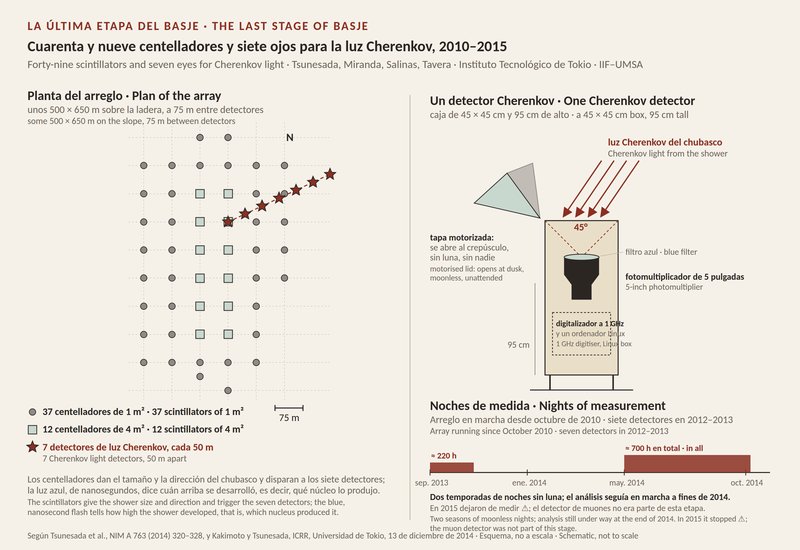
October 2010.Yoshiki Tsunesada (then at Tokyo Institute of Technology; today professor at Osaka Metropolitan University) commissioned with Pedro Miranda, Juan Salinas and Wilfredo Tavera, of the IIF, a hybrid system: an array of 49 scintillation counters over 500 × 650 m and seven new non-imaging Cherenkov detectors set in a radial line 50 m apart from the centre, with 10–100 ns signals digitised at 1 GHz, for showers above 3 × 10¹⁵ eV. The aim: the composition above the knee, in the region where galactic cosmic rays give way to extragalactic ones. In 2011 the array's data-acquisition system was renewed.
2012–2014: seven boxes that open by themselves. Each Cherenkov detector was a 45 × 45 cm box, 95 cm tall, with a single five-inch photomultiplier (Hamamatsu R1250) under a blue filter, a 1 GHz digitiser and a small Linux computer; a motorised pyramidal lid opened at dusk on moonless nights and the whole ran with nobody on the mountain, triggered by the scintillator array (schematic dated 12 September 2012). The seven were set in a line, 50 m apart, from the centre of the array. They measured in September and October 2013 (some 220 hours) and from May to early October 2014, accumulating some 700 hours; at the end of 2014 the analysis was still under way. In 2014 the Laboratory had three physicists, one technician and four workers on its staff, and the Japanese side —Katsuya and Tajima from April to July; Tsunesada and Nakayama from July to October— took turns on the mountain on an annual ICRR budget of 2.3 million yen.
2015. The surface array and the Cherenkov project stopped taking data ⚠ (Institute director, 20 September 2026). The muon detector of the Rossi hall was not part of that last stage: its closing date remains to be fixed.
Direct detection of Cherenkov light. Unlike imaging Cherenkov telescopes, these detectors look at the sky with a single wide-field photomultiplier and record the time profile of the flash. At 5,200 m, with half the atmosphere below, the shower arrives young and the profile keeps the imprint of its longitudinal development, that is, of the primary mass. It is the same reason the mountain served for everything else.
The last stage of BASJE: plan of the 2010 array, the line of seven Cherenkov light detectors 50 m apart, a section of one of the boxes and the measuring nights of 2013–2014. Diagram: IIF–UMSA, after Tsunesada et al. (2014) and Kakimoto and Tsunesada, ICRR (2014).
Chronology of the milestone
Date
Event
1958
Proposal by Satio Hayakawa (according to Kampert and Watson, 2012); pilot experiment at El Alto, forerunner of BASJE.
1959
Minoru Oda travels to Moscow and discusses showers with Escobar and with his former teacher Bruno Rossi.
5 January 1962
Supreme decree on the lead (President Víctor Paz Estenssoro; number to be established): the Banco Minero hands over the lead ore against future tin royalties. ⚠
Early 1961
The first electron-density detectors are installed. More than 60 tonnes of equipment arrive through Arica and Mollendo.
1963
First scientific results from BASJE.
January 1962
BASJE goes into operation ("in operation since January of this year", 1962 report).
1962
Report to the Pontifical Academy of Sciences (study week on cosmic rays in interplanetary space, Vatican City): Clark, Escobar, Murakami and Suga present the first six months, including the first muon-poor showers. Published in Scripta Varia 25 (1963).
May 1965
Carlos Aguirre joins BASJE under the direction of Koichi Kamata. Kevin MacKeown, Antonio Mogro, Andrés Trepp and Oscar Saavedra join as well.
June 1965
Charles Forline arrives in La Paz and returns to the United States without going up.
1960s
Michigan installs a 60-inch cloud chamber and Cherenkov detectors. Spark chambers. Detection of radio pulses.
Late 1960s
MIT leaves the project; the University of Maryland comes in.
1969
The surviving-primary-proton experiment begins.
January 1972
Aguirre presents his work in Kyoto and talks with Hideki Yukawa.
1972
The proton experiment ends; the enlargement for large showers begins.
1973
The groups from Saitama University (Tsuneo Matano) — the SYS experiment — and from the University of Turin (Giani Navarra) arrive, both to study small air showers.
Il Nuovo Cimento: proton–air cross-section between 3.4 and 8.8 TeV, ahead of the accelerators.
1982
Larry W. Jones (Michigan) records in writing that the Laboratory's programmes, "near a minimum" in 1970, have recovered. Third external endorsement in the dossier.
1980s–1990s
SYS becomes a hybrid instrument — nuclear emulsions + shower detector — and sweeps eight X-ray sources and the galactic centre. All results negative.
2000
The Turin group is still publishing from Chacaltaya: twenty-seven years of continuous Italian presence.
September 1987
Kakimoto's group starts the small array (MAS): 33 scintillators over 8,000 m².
August 2001 – October 2002
Cherenkov light detectors in the MAS: the composition at the knee comes out heavier than carbon.
October 2010
Tsunesada commissions the hybrid system: 49 scintillation counters over 500 × 650 m and seven new Cherenkov detectors, with Miranda, Salinas and Tavera.
2013–2014
The seven Cherenkov detectors measure some 700 hours of moonless nights (Sept.–Oct. 2013; May–Oct. 2014), with nobody on the mountain.
2015
The surface array and the Cherenkov project stop taking data ⚠; the muon detector was not part of that stage.
Open points
⚠ The lead decree. Aguirre's footnote is damaged in transcription: the number “111786” given by the OCR is impossible — 1962 decrees have four digits — and neither the quantity of material nor the figure in dollars can be read with confidence. The check against the index of the Gaceta Oficial (19 September 2026) also rules out the date: the decrees of 5 January 1962 run from 5952 to 5961 and none concerns the Banco Minero or lead. The printed page of the book must be consulted for number and date. It is the third instrument of state in the dossier.
⚠ The spelling of Dardo Beramendi / Veramendi. Aguirre writes one form; the photographic archives, another.
⚠ What closed in 2015 and what did not. According to the director, in 2015 the surface array and Tsunesada's Cherenkov light project stopped measuring, not the muon detector of the Rossi hall. Missing: the month and form of the closure; the date on which the muon detector stopped taking data; and the final results of the 2010–2015 hybrid system: the December 2014 talk (source 19) gives them as "under analysis", and no later publication has been located. The talk counts 50 scintillators where the technical paper counts 49.
⚠ The state of the muon detector.This is the most important question in this milestone for the dossier. The 60 m² detector with its shield of galena and concrete on a reinforced-concrete structure is by a wide margin the most substantial material element the Laboratory has ever built. A heritage dossier needs to know what remains of it, in what condition, and what conservation plan is in place. See §14.
⚠ The two SYS exponents. The transcription of Aguirre's book loses the exponents in the two passages on SYS ("10^n eV"). The first is almost certainly 10¹⁴ eV from the context — "small showers" — but neither figure should be quoted without collating the printed page.
⚠ When SYS ended, or whether it continues. Aguirre writes "to date" in 1996; the group was still publishing in 2000. (The expansion of the acronym is already settled: §10.6.)
✅ The Pontifical Academy reference is now complete (source 2): the copy is at the IIF and its pages 1–5 and fig. 7 were photographed on 19 September 2026. Aguirre cited it as 1964 under another title.
The muon detector as an element of the property
This milestone calls for an observation that goes beyond the narrative.
The nomination to UNESCO does not protect an idea: it protects a place and what is in it. And the most important constructed object in that place is BASJE's muon detector: fifteen modules of four square metres, a shield of galena — lead ore donated by the State — and concrete, a reinforced-concrete structure raised at 5,200 metres with material hauled up from two Pacific ports.
On that object, the dossier needs:
A condition report, with current photographs.
The original plans, if they exist, or a new survey.
A statement on what is preserved and what has been dismantled.
A conservation plan, however minimal. A heritage property with no conservation plan is hard to defend.
A decision on whether the detector should be accessible to visitors, and under what conditions.
Without this, milestone 06 is a magnificent story about something that can no longer be seen. With it, it is the material heart of the nomination.
The case for the UNESCO nomination
Short form (for the page):
Fifty-four years of the same experiment on the same site, from 1961 to 2015. In that time it gave the first evidence that cosmic rays of the highest energies escape from the galaxy, measured the proton–air cross-section ahead of the accelerators, and opened up gamma-ray astronomy.
Developed form (for the dossier):
Exceptional continuity of the series. Fifty-four years of uninterrupted operation of the same experiment in the same place is a rarity in the history of experimental physics. For a heritage dossier it is, moreover, the best possible proof of integrity: the scientific use of the property was never interrupted.
Two results that ran ahead of world instrumentation. The evidence for galactic escape — "a point of reference for all the studies of cosmic rays carried out in the world today", in Aguirre's words — and the measurement of the proton–air cross-section between 3.4 and 8.8 TeV before the accelerators reached that range. A Bolivian mountain measured, with detectors buried under lead, something the most expensive machines in the world could not yet reach.
The opening of a discipline. BASJE took the pioneering steps of very-high-energy gamma-ray astronomy. That line runs unbroken to ALPACA, which on the same mountain will observe the southern sky above 100 TeV (milestone 10). The continuity is not only of the site: it is of the scientific programme.
A cooperation that built a community. MIT, Tokyo, IPCR, Michigan and Maryland passed through the project and left; the Bolivian and Japanese teams stayed on for another forty years. The site was not a way-station for foreign expeditions: it trained and sustained a local scientific group, whose names are documented.
A site that produced an instrument of its own. In the 1980s the SYS experiment fused the two great techniques the Laboratory had housed separately for twenty years — the emulsion chamber and the surface array — into a single hybrid apparatus. Chacaltaya was not merely a hospitable site: it was a place where instrumentation evolved. And the line of gamma-ray astronomy — BASJE 1961 → SYS 1980s → OMEGA 1989 → ALPACA today — is continuous over sixty years, with no gap (§10).
An object exists. The muon detector is the material element that gives the nomination its physical support. Documenting its condition is a priority (§14).
Sources
Carlos Aguirre Bastos, Medio siglo de ciencia en Bolivia. El Laboratorio de Física Cósmica de Chacaltaya de la UMSA, Fundación Universitaria Simón I. Patiño, La Paz, 1996, ch. "El proyecto BASJE".
G. Clark, I. Escobar, K. Murakami and K. Suga, "Extensive Air Showers at 5200 metres above sea level and search for high energy primary gamma rays", in Semaine d'étude sur le problème du rayonnement cosmique dans l'espace interplanétaire, Pontificiae Academiae Scientiarum Scripta Varia 25, Vatican City, 1963 (study week of 1962), pp. 29 ff. Copy at the IIF; pages photographed on 19 September 2026. ⚠ Aguirre cites the volume as 1964.
H. Bradt et al., Proceedings of the International Conference on Cosmic Rays. ⚠ Reference to be completed.
C. Aguirre et al., "Energy spectrum of surviving primary protons with energies (3–30) TeV at 5,200 m.a.s.l. and the cross-section for proton–air nucleus collisions", Il Nuovo Cimento, vol. 27 B, no. 2, June 1975.
C. Aguirre, "Correlation of pulsar positions and the arrival directions of air showers observed at Chacaltaya", J. Phys. A: Math. Nucl. Gen., vol. 7, no. 12, 1974.
C. Aguirre et al., "Electrons in large air showers observed at 5,200 m above sea level", J. Phys. G: Nucl. Phys., vol. 5, no. 1, 1979.
C. Aguirre, "La relación neutrones a protones en Chacaltaya", Resumen de Labores, no. 46, May 1972; and "Determinación del camino libre medio de colisión de partículas primarias observadas en Chacaltaya", Resumen de Labores, no. 52, 1973/74, p. 123.
Supreme decree on the BASJE lead, January 1962. ⚠ Number and date to be established from Aguirre's printed page; it is not among the decrees of 5 January 1962 (5952–5961).
N. Inoue et al., "Very High Energy Gamma Rays with Energies Above 10^n eV Observed at Mt. Chacaltaya", Nuclear Physics B (Proc. Suppl.) 14B (1990), North-Holland. ⚠ Exponent to be collated.
R. Ticona et al., "Studies on UHE Gamma Rays at Southern Hemisphere". Various papers and doctoral theses.
L. W. Jones, "Remarks Concerning Cosmic Ray Physics in Latin America", Workshop on High Energy Interactions, Rio de Janeiro, July 1982. Cited by Aguirre (1996).
A. Castellina, P. L. Ghia, F. Kakimoto, T. Kaneko, C. Morello, G. Navarra, K. Nishi, O. Saavedra, G. Trinchero, D. Urzagasti, P. Vallania, A. Velarde, H. Yoshii, "Search for gamma-ray bursts with the single particle technique at Mt. Chacaltaya", ~2000. astro-ph/0011241
"Hadronic- and electromagnetic-cores of air-showers observed by hybrid experiments at high mountains", arXiv:1010.2708.
"Boost for Andean cosmic ray laboratory", CERN Courier, 30 October 2000.
C. Aguirre et al., "Simultaneous observation of families and accompanied air showers at Mt. Chacaltaya. II", Physical Review D62, 032003 (2000).
F. Kakimoto, S. Ogio, Y. Shirasaki, N. Gironda, T. Kaneko, H. Yoshii, T. Baba, K. Nishi, N. Tajima, Y. Yamada, S. Shimoda, H. Nakatani, E. Gotoh, Y. Toyoda, K. Murakami, Y. Matsubara, Y. Mizumoto, W. Velásquez and A. Velarde, "A small air-shower array at Mount Chacaltaya", Nuclear Instruments and Methods in Physics Research A, vol. 373, 1996, pp. 282–289. doi:10.1016/0168-9002(95)01508-6.
H. Tokuno, F. Kakimoto, S. Ogio, D. Harada, Y. Kurashina, Y. Tsunesada, N. Tajima, Y. Matsubara, A. Morizawa, O. Burgoa, E. Gotoh, K. Kadota, T. Kaneko, M. Kubo, P. Miranda, T. Mizobuchi, Y. Mizumoto, K. Murakami, H. Nakatani, K. Nishi et al., "The cosmic ray primary composition at the knee region from lateral distributions of atmospheric Čerenkov photons in extensive air showers", Astroparticle Physics, vol. 29, no. 6, 2008, pp. 453–460. doi:10.1016/j.astropartphys.2008.05.001.
Y. Tsunesada, R. Katsuya, Y. Mitsumori, K. Nakayama, F. Kakimoto, H. Tokuno, N. Tajima, P. Miranda, J. Salinas and W. Tavera, "New air Cherenkov light detectors to study mass composition of cosmic rays with energies above knee region", Nuclear Instruments and Methods in Physics Research A, vol. 763, 2014, pp. 320–328. doi:10.1016/j.nima.2014.06.054.
F. Kakimoto and Y. Tsunesada, "ボリビア空気シャワー共同実験 (BASJE)" [Bolivian Air Shower Joint Experiment], talk at the results meeting of the inter-university research programme of the Institute for Cosmic Ray Research (ICRR), University of Tokyo, 13 December 2014, 20 slides (file ICRR-2014-Bolivia.key, exported to PDF). Copy at the IIF–UMSA.
Internal research note: nota_SYS_y_la-colaboracion-brasil-japon.md (September 2026), in this same folder.
How to cite this page
«1960–2015 · BASJE and the First Steps of Gamma-Ray Astronomy». Chacaltaya Cosmic Ray Laboratory, Instituto de Investigaciones Físicas, UMSA. https://chacaltaya.umsa.bo/en/
This site is being built
The Chacaltaya Cosmic Ray Laboratory is a candidate for World Heritage status. If you hold documents, photographs or memories of the Laboratory, the project would like to hear from you.