
This is the only milestone in the narrative that has not ended. In 1989 the Laboratory proposed, together with the University of Tokyo, an instrument called OMEGA that was never built. Twenty-seven years later, in May 2016, a Japanese Nobel laureate travelled up to Bolivia to give its heir a push. ALPACA is under construction on the same mountain, and it will be the first instrument able to observe the sky of the southern hemisphere in gamma rays above 100 TeV — the hemisphere in which the centre of our galaxy lies.
Why this milestone closes the narrative
The nine preceding milestones document what happened. This one documents what is happening, and that changes the nature of the nomination.
A dossier submitted to UNESCO may protect a ruin or it may protect a living institution. These are not the same thing, and the case is not made in the same way. The criteria of integrity and authenticity that UNESCO assesses are satisfied very differently when the original use of the property has never been interrupted: here there is no lost function to reconstruct, there is a continuing function to document.
This milestone is the proof of that. And it has a further, useful symmetry: it begins with a failure.
1989: the OMEGA proposal
In 1989, a group of researchers from the Laboratory proposed, together with the Cosmic Ray Research Laboratory of the University of Tokyo, an experiment called OMEGA — Observation of Multiple Particle Production, Exotic Interactions, Gamma Ray Air Showers and Heavy Primaries.
The planned instrument:
| Component | Specification |
|---|---|
| Central emulsion chamber | close to 900 m², covered with scintillating optical fibre, which would give the position, arrival time and size of the electromagnetic component of the shower |
| Surface array | 80 plastic scintillators spread over 40,000 m², to determine the density, "age" and arrival direction of the shower |
The stated aims, in the words of the proposal:
- To increase the number of events observed in the range 10¹⁵–10¹⁶ eV ⚠.
- To measure the composition of the primary cosmic rays near 10¹⁶ eV ⚠.
- To examine the showers of primaries with energies of the order of 10¹⁶ eV ⚠, which reach their maximum development at Chacaltaya.
- To clarify the character of the exotic interactions found by the Brazil–Japan Collaboration (milestone 07), comparing the events in the central detector with those from CERN and Fermilab.
- To observe gamma-ray sources above 6×10¹⁴ eV ⚠ located in the galactic centre and its surroundings.
In his book Aguirre includes a table of the candidate gamma-ray sources OMEGA was to observe, with their right ascension, declination, object type and minimum zenith angle at Chacaltaya: the Crab Pulsar, Geminga, the Vela Pulsar, Vela X-1, PSR 0950+08, Virgo A, Centaurus A, Sco X-1, X1700-37, X1822-37, PSR 1929+10, X1907+09, PSR 1937+21 and SS433.
That table is the key document of this milestone, and it should be reproduced on the site exactly as it stands. It is the list of what Chacaltaya wanted to look at in 1989 and could not. Set beside ALPACA's scientific programme, it shows in a single image that the ambition remained intact for thirty-five years.
⚠ The exponents. The OCR transcription of the book loses the exponents throughout this passage. The figures above are reconstructions from context and none of them should be cited without checking against the printed page.
OMEGA was not built. The sources consulted do not say why.
What did happen in the meantime
Twenty-seven years passed between the proposal and its heir, and the mountain was not idle. This is worth saying, because otherwise the milestone looks like a leap into the void.
- May 1986. The SYS experiment (milestone 06) verified a significant excess of hadron-poor showers, with energies above 10¹⁴ eV ⚠, coming from the direction of the X-ray binary system Scorpius X-1. A survey along the galactic plane also showed an excess of diffuse gamma emission in the ranges 50 to 150 and 200 to 300 degrees of right ascension.
- The University of Turin group (milestone 06) observed gamma-ray arrival directions through small showers, and in particular Supernova 1987A — the closest supernova observed since the invention of the telescope, and visible only from the southern hemisphere.
- 1992–1994. Nagoya University installed in the spring of 1992, on top of the Rossi hall, a solar neutron telescope — the third of its international network, in operation since September of that year — and in 1994 the cooperative project was formalised with the committed support of the National Academy of Sciences: letter from Carlos Aguirre to the Ambassador of Japan, 23 March 1994 (milestone 09, §6.1).
- And since 2008, the LAGO Cherenkov detectors (milestone 09).
Editorial note. Those 1986 results are, as far as the sources go, the closest Chacaltaya ever came to a gamma-ray source detection. They deserve to be checked against the published literature before they are given weight in the dossier: see §11.
2 May 2016: a Nobel laureate climbs the mountain
On 2 May 2016 Takaaki Kajita arrived in Bolivia — Nobel Prize in Physics 2015 for the discovery of neutrino oscillations, and at that time director of the Institute for Cosmic Ray Research (ICRR) of the University of Tokyo.
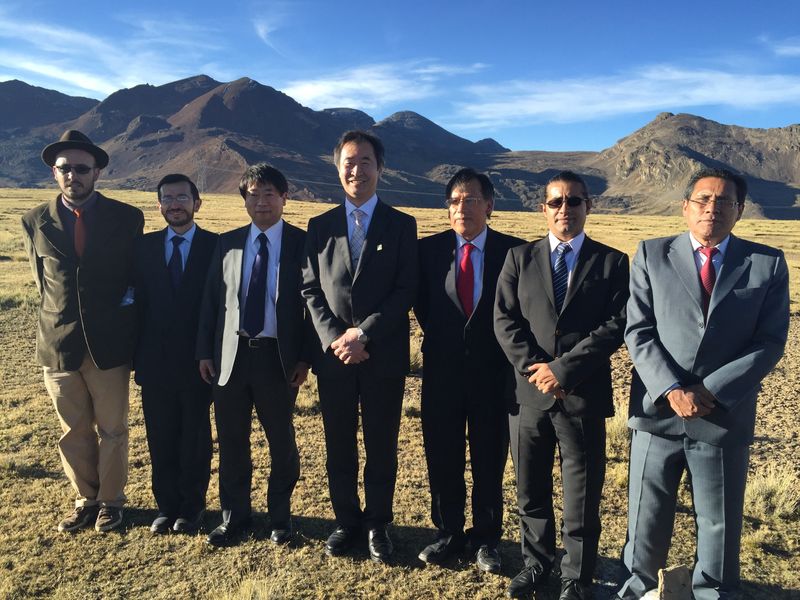
The **Universidad Mayor de San Andrés awarded him the degree of doctor honoris causa, and the Municipal Council of La Paz declared him a distinguished guest, expressly recognising his support for the new cosmic-ray observatory being installed near Mount Chacaltaya**.
Why this visit belongs in the dossier and not in the news section. The ICRR in Tokyo is the successor institution of the Institute for Nuclear Study, from which came, in 1959, the two tickets to Moscow that gave rise to BASJE and to the Brazil–Japan Collaboration (milestones 06 and 07). Fifty-seven years later, the director of that same house returns to the same mountain to sign the next experiment. The continuity of the relationship with Japanese physics — 1959, 1961, 1962, 1973, 2016 — is one of the longest and best documented international-cooperation arguments the site has.
ALPACA
ALPACA — Andes Large-area PArticle detector for Cosmic-ray physics and Astronomy — is the project that began in 2016 between Bolivia and Japan, with the participation of Mexico as well.
| Location | The Chacaltaya plateau, on the outskirts of La Paz |
| Altitude | 4,740 m a.s.l. |
| Surface array | 83,000 m², with 401 scintillation detectors |
| Muon detector | 5,400 m² underground, in four water Cherenkov pools. Under construction as of September 2026 |
| Partners | ICRR of the University of Tokyo · IIF–UMSA · institutions in Mexico |
What it is after:
- To observe ultra-high-energy gamma rays in the southern hemisphere.
- To find out which astrophysical objects accelerate cosmic rays above 10¹⁵ eV — the so-called PeVatrons.
- To study energy distributions, the anisotropy of cosmic rays and solar magnetic fields.
The principle is that of BASJE. A surface array that detects the shower, and underground a muon detector that distinguishes the muon-poor showers — those produced by gamma rays — from the far more abundant background of charged cosmic rays. It is exactly the method that Suga, Escobar, Rossi and Clark installed on this mountain in 1961 (milestone 06), with sixty years of instrumentation in between.
As of September 2026 that muon detector is still being built. The surface array is already in place on the plateau; the underground part — the one that separates gamma-ray showers from the far more abundant background of charged cosmic rays, and therefore the one that turns the array into a telescope — is under construction. This is worth stating plainly, because it is what makes the milestone strong: the site is not showing a finished instrument but one being raised right now.
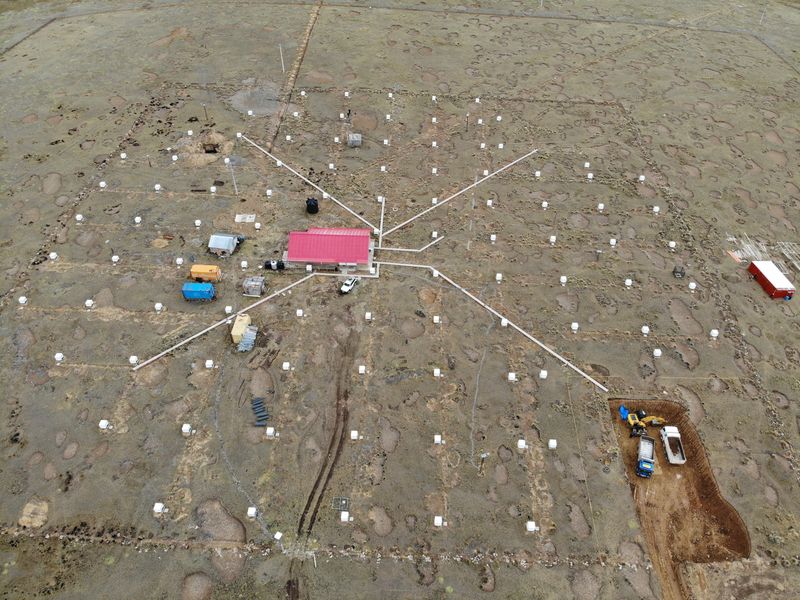
The sentence that sums up this milestone was already written, in 1992, by Tsuneo Matano, Koichi Suga and Yoshio Toyoda, commenting on a new array elsewhere in the world: "The new array, which costs millions of dollars, is bigger and better than ours of 30 years ago, but the principle is the same." At Chacaltaya, three decades later, the new array is ALPACA.
ALPAQUITA: the prototype is already taking data
And this is what stops the milestone from being a promise.
ALPAQUITA is the prototype of ALPACA, and it is in operation:
| Area | 18,450 m² — roughly one quarter of ALPACA |
| Detectors | 97 plastic scintillators of 1 m², on a 15 m grid |
| Muon detector | 900 m² in 16 cells, planned. It does not exist yet: construction of the underground muon detectors began in late October 2025 |
| First observations | September 2022 |
| Stable operation | Since April 2023 |
And it already has a result that shows it works. The array detected the Moon shadow in the cosmic rays with a statistical significance of 8σ. The Moon shadow is the calibration standard for instruments of this type: the Moon blocks the cosmic rays that would come from its direction, and the deficit observed makes it possible to measure the angular resolution and the pointing accuracy of the detector. ALPAQUITA's came out at approximately 1.0°, in agreement with the simulations.
In plain English: the instrument sees what it is supposed to see, with the accuracy expected.
The simulations published by the collaboration estimate that ALPAQUITA on its own could detect five sources above 10 TeV with 5σ significance in one year of observation, and that HESS J1702-420A would be detectable above some 300 TeV within a year, if its spectrum continues without a cut-off.
Why the southern hemisphere, and why this mountain
This is the scientific argument of the milestone, and it is strong because it is geographical — that is, non-transferable.
The great very-high-energy gamma-ray observatories operating today — Tibet ASγ, LHAASO, HAWC — are all in the northern hemisphere. From there, much of the southern sky is out of view.
And in the southern sky is the following:
- The centre of our galaxy, which the northern-hemisphere experiments cannot observe.
- Around a hundred known sources of very-high-energy gamma rays.
- The best PeVatron candidates — the natural accelerators that push protons beyond 10¹⁵ eV, the range of the spectral "knee" that BASJE measured for the first time from this very mountain in the 1960s (milestone 06).
There is today no instrument capable of observing the southern sky in gamma rays above 100 TeV. ALPACA will be the first.
And the reason it is being built here is the same as in 1942, 1947, 1961 and 1962: altitude. A shower initiated by a gamma ray of those energies reaches its maximum development at this height; measured from sea level, it has already died out.
It is the same argument as milestone 07 put in other words. The instrument cannot go anywhere else. The mountain is not the setting of the experiment: it is one of its physical conditions.
A CERN of the South, without accelerators
Around all this a larger-scale idea is growing, and the site should record it, because it places Chacaltaya within a regional movement rather than an isolated effort.
Vieira and Videira describe the birth of a movement in favour of creating what has provisionally been called the Regional Astroparticle Institute: an administrative infrastructure for the large scientific projects, present and future, that take advantage of South American nature. In the definition given by one of its promoters, the physicist Ronald Shellard, of the Centro Brasileiro de Pesquisas Físicas:
"A CERN of the South without accelerators." (translated from the Portuguese original: "Um CERN Sul sem aceleradores")
What that institute would bring together:
| Natural resource | Where |
|---|---|
| The plain | The Argentine pampas |
| The absence of rain | The Atacama Desert, Chile |
| The shielding of kilometres of rock for an underground laboratory | The Andes range |
| Altitude | Chacaltaya |
| The sky of the southern hemisphere | The whole Southern Cone |
And the same authors close their essay with a sentence the site ought to use:
"It is the mountain of the South that dared to take on the machines of the North."
A question the dossier has to settle: where the property is
This is the most important practical point in this milestone, and it cannot be left unanswered.
| Installation | Altitude |
|---|---|
| Summit weather hut (1943) | 5,600 m |
| LAGO detectors | 5,270–5,280 m ⚠ |
| GAW/CHC station | 5,240 m |
| Cosmic Ray Laboratory | 5,200 m |
| ALPACA / ALPAQUITA | 4,740 m |
ALPACA is not in the Laboratory building. It is on the Chacaltaya plateau, some four hundred and sixty metres further down, on a flat expanse that needs 83,000 m² of level ground — something the summit does not offer.
That raises three questions the dossier must answer explicitly:
- Does the perimeter of the proposed property include the ALPACA plateau? If the central argument of the nomination is that the site remains an active scientific centre, and the most important active experiment lies outside the perimeter, the argument is weakened.
- How is the property articulated with its buffer zone? A serial property, or a property with several components, may be the appropriate technical answer.
- How is heritage protection to be reconciled with the construction of new scientific facilities? A heritage property imposes restrictions on new building work. ALPACA is under construction right now. This is not an obstacle — it is normal at scientific heritage sites — but it requires a written agreement between the nomination project and the ALPACA collaboration before the dossier is submitted, not after.
My recommendation. Treat this as an opportunity and not as a problem. A dossier that arrives with a management plan agreed with the experiment in progress demonstrates exactly the management capacity that UNESCO assesses. One that discovers the contradiction during the evaluation does not.
Chronology of the milestone
| Date | Event |
|---|---|
| May 1986 | SYS verifies an excess of hadron-poor showers from the direction of Scorpius X-1, and an excess of diffuse gamma emission along the galactic plane. |
| 1980s | The Turin group observes gamma-ray arrival directions, in particular from Supernova 1987A. |
| 1989 | OMEGA is proposed with the Cosmic Ray Research Laboratory of the University of Tokyo: a 900 m² emulsion chamber and 80 scintillators over 40,000 m². It is never built. |
| 1992 – 1994 | Nagoya University installs the solar neutron telescope (April–September 1992); in 1994 the project is formalised with the support of the National Academy of Sciences (milestone 09). |
| 2008 | The LAGO detectors begin taking data (milestone 09). |
| 2015 | Takaaki Kajita receives the Nobel Prize in Physics for the discovery of neutrino oscillations. |
| 2 May 2016 | Kajita arrives in Bolivia. UMSA awards him the **doctorate *honoris causa***; the Municipal Council of La Paz declares him a distinguished guest for his support of the new observatory. |
| 2016 | The ALPACA project begins, between Bolivia and Japan, with the participation of Mexico. |
| September 2022 | ALPAQUITA begins observing. |
| April 2023 | ALPAQUITA operates stably. |
| 2024 | The collaboration reports the detection of the Moon shadow at 8σ and an angular resolution of ~1.0°. The underground muon detectors are planned for construction. |
| Late October 2025 | Construction of the underground muon detectors begins. Until then ALPAQUITA had operated with its surface array alone. |
| 11–22 November 2025 | The surface array is in place and the muon detector is being excavated. State documented photographically by Kazumasa Kawata (§5). |
| 2025 → | Construction of the full array: 401 detectors over 83,000 m² and 5,400 m² of muon detector. ⚠ Schedule to be confirmed. |
| Today | ALPACA will be the first instrument able to observe the southern sky in gamma rays above 100 TeV. |
Open points
⚠ The exact state of the muon detector. As of September 2026 it is under construction (§5). It remains to be established how much of the 5,400 m² has been built and the expected commissioning schedule. ✅ Settled by the IIF Directorate (19 September 2026): ALPAQUITA has no muon pool built yet; construction of the underground detectors began in late October 2025. To date the prototype has measured with its surface array alone.
⚠ Why OMEGA was not built. No source consulted says so. It is a legitimate question, and the answer — lack of funding, a shift in scientific priorities, the institutional instability of the 1980s — would be informative for the dossier, because it documents the fragility of a scientific site with neither protection nor stable funding. Ask Carlos Aguirre and the ICRR.
⚠ The 1989 OMEGA proposal as a document. "Experiment OMEGA: Observation of Multiple Particle Production, Exotic Interactions, Gamma Ray Air Showers and Heavy Primaries", C. Aguirre et al., Cosmic Ray Research Laboratory, University of Tokyo, 1989. Locate it. With its table of candidate sources it is an excellent exhibition piece.
⚠ All the exponents in this milestone. The transcription of the book loses them systematically. Check against the printed page before publishing any energy figure.
⚠ The Scorpius X-1 excess of May 1986. Was it published? Was it later confirmed, or discarded? It is a source result that, if it holds up, is important; and if it does not hold up, the site must say so — the same rule as with Centauro (milestone 07).
⚠ The ALPACA schedule. How many detectors are installed today, what state the underground muon detectors are in, and when the full array is expected. Ask the collaboration directly; it is based at UMSA itself.
⚠ ALPACA's Mexican partners: exactly which institutions.
⚠ The UMSA–ICRR agreement that formalised ALPACA: date, signatories, text. It would be the contemporary equivalent of the 1952 CBPF–UMSA agreement (milestone 03).
⚠ The status of the Regional Astroparticle Institute. The source dates from 2015/2019. Did it progress? Is there any formal structure today? Ask the CBPF and Ronald Shellard.
⚠ The delimitation of the property with respect to the ALPACA plateau. See §9. This is not an open research point: it is a decision the project has to take.
The material element of this milestone
It is the only milestone whose object is growing, and that inverts the usual approach.
- Document ALPAQUITA and the ALPACA works photographically, now. Ten years from now, the construction photographs will be heritage; today they are just a building site. It is the only part of the dossier where the project can create an archive instead of searching for one.
- Record on video the testimony of those who are building it, especially the Bolivian technicians. It is what was not done in 1961 and what we now lack for BASJE.
- Agree with the ALPACA collaboration on the regime for reconciling scientific construction with heritage protection (§9).
- Preserve the 1989 OMEGA proposal and its table of candidate sources.
- Decide whether visitor access to ALPACA is possible and under what conditions, and coordinate it with the same decision regarding the GAW station (milestone 09).
The case for the UNESCO nomination
Short form (for the page):
In 1989 Chacaltaya proposed an instrument that was never built. Today, on the same mountain, ALPACA is rising: the first detector able to observe the sky of the southern hemisphere in gamma rays above 100 TeV, where the centre of our galaxy lies. The property is not protected as a ruin, but as a scientific asset with a committed future.
Developed form (for the dossier):
- Integrity demonstrated by continuity of use. The integrity criterion is met here in the most solid way possible: the scientific use of the property was never interrupted, and there is international investment committed for the coming decades. This is not a request to protect the memory of a function; it is a request to protect a function that is active.
- The exceptional character of the site is revalidated in every generation. 1942 the actinometer, 1947 Lattes's plates, 1961 BASJE, 1962 the emulsion chamber, 1973 SYS, 2008 LAGO, 2011 the GAW station, 2022 ALPAQUITA. Eight independent decisions, taken by different institutions from different countries over eighty years, that this point on Earth is the right place. No rhetorical argument matches that series.
- A world first in progress, not in the past. No instrument in the world observes the southern sky in gamma rays above 100 TeV today. When ALPACA does, it will be from here — and for the same physical reason that led Lattes to choose this mountain in 1947: altitude.
- The relationship with Japanese physics is almost seventy years old. From the two tickets to Moscow in 1959 to Takaaki Kajita's doctorate honoris causa in 2016, by way of Suga, Kamata, Matano, Fujimoto and Hasegawa. It is one of the longest documented bilateral scientific cooperations between Japan and a Latin American country, and all of it has a single place as its object.
- And the site is part of a regional movement. The projected Regional Astroparticle Institute — "a CERN of the South without accelerators", in the Portuguese original — places Chacaltaya alongside the Argentine pampas, the Atacama Desert and the rock of the Andes as one of South America's natural resources for science. The nomination does not protect an isolated case: it recognises the oldest of those resources, the only one with eighty years of documented use.
Sources
- Carlos Aguirre Bastos, Medio siglo de ciencia en Bolivia. El Laboratorio de Física Cósmica de Chacaltaya de la UMSA, Fundación Universitaria Simón I. Patiño, La Paz, 1996 — ch. XII, "Perspectivas futuras", and ch. XI.
- C. Aguirre et al., "Experiment OMEGA: Observation of Multiple Particle Production, Exotic Interactions, Gamma Ray Air Showers and Heavy Primaries", Cosmic Ray Research Laboratory, University of Tokyo, 1989. ⚠ To be located.
- ALPACA Experiment, the collaboration's official site:
alpaca-experiment.org. - M. Anzorena et al. (ALPACA Collaboration), "A new air shower array in the Southern Hemisphere looking for the origins of Cosmic rays: the ALPACA experiment", 22nd International Symposium on Very High Energy Cosmic Ray Interactions (ISVHECRI 2024), July 2024. arXiv:2412.14550
- ALPACA Collaboration, "Detectability of southern gamma-ray sources beyond 100 TeV with ALPAQUITA, the prototype experiment of ALPACA", Experimental Astronomy, 2021. arXiv:2109.13490
- ALPACA Collaboration, "The ALPACA experiment: the project of the first sub-PeV gamma-ray observation in the southern sky", 2022. arXiv:2208.14659
- "Premio Nobel de Física llega a Bolivia y la UMSA le otorga el título de doctor honoris causa", Agencia de Noticias Fides, May 2016; and related items from UMSA and La Razón.
- Cássio Leite Vieira and Antonio Augusto Passos Videira, "Chacaltaya: um laboratório nas nuvens", Scientific American Brasil, January 2015; in História da Física (2019), pp. 129–141 — for the Regional Astroparticle Institute and the Ronald Shellard quotation.
This site is being built
The Chacaltaya Cosmic Ray Laboratory is a candidate for World Heritage status. If you hold documents, photographs or memories of the Laboratory, the project would like to hear from you.
Get in touch