A cosmic-ray institute as the documented origin of a country's scientific system
Milestones 08
Chacaltaya did not only produce physics: it produced institutions. Out of the Laboratory's activity came the country's nuclear energy commission, Bolivia's first computing centre, today's Facultad de Ciencias Puras y Naturales (Faculty of Pure and Natural Sciences), the degree programme in Electronic Engineering, the Instituto Geofísico Boliviano (Bolivian Geophysical Institute) and much of the state apparatus for science policy. It is the only milestone that does not talk about particles, and probably the strongest in the dossier.
What this milestone claims, and why it matters
The seven preceding milestones argue scientific value: what was discovered here. This one argues something different and, for UNESCO, complementary: cultural value. It holds that a high-altitude laboratory was the documented origin of an entire country's scientific system.
Aguirre puts it with a caution worth preserving, because it is more credible than the maximal claim (translated from the Spanish):
"All these institutions would surely have developed at some point in the history of Bolivian science, but it was the vigorous presence of the Laboratory that allowed them to grow early, rapidly and coherently. Thus, in a world of rapid technical change and profound transformations, the mere presence of an institution such as the Chacaltaya Laboratory, even while studying cosmic particles exclusively, fully justifies its existence, because of the catalysing effect that only an institution of prestige can achieve with relative ease."
The site must say exactly that: catalyst, not sole progenitor. The moderate claim is verifiable; the maximal one is not.
The starting point: 7 June 1956
On 7 June 1956, Ismael Escobar submitted to the rector's office of UMSA a proposal to create an Instituto Nacional de Investigaciones Nucleares (National Institute of Nuclear Research).
The rector, Gastón Aráoz, accepted the proposal and added something to it: he suggested creating within it a "Departamento de Investigaciones Matemáticas" (Department of Mathematical Research), on the grounds that the development of that science in Bolivia was urgent. Escobar accepted the suggestion and proposed, to head it, the mathematician Wilhelm Damköhler, of the University itself.
That document — a laboratory director's proposal to his rector — is the starting point of everything that follows.
Nuclear energy
Out of that initiative came, according to Aguirre, the Comisión Boliviana de Energía Nuclear (Bolivian Nuclear Energy Commission), whose activities began in March 1962, created "under the umbrella" of the Laboratory and with Escobar as its first director.
The ground had been prepared earlier: in the late 1950s, Escobar, Hartmann and Jorge Muñoz Reyes travelled to Knoxville, in the United States, on a mission that made it possible to draw up the Commission's first plans. And it had an immediate, very concrete consequence: Dr Luis Barragán was given a scholarship to Brazil to train in nuclear applications in medicine. In 1996 he was still heading the Centro de Medicina Nuclear (Nuclear Medicine Centre).
Bolivian nuclear medicine begins, indirectly, in a cosmic-ray laboratory.
The International Geophysical Year and the Instituto Geofísico Boliviano
This is the best-documented line of the milestone, because it has decrees behind it.
The Laboratory's successes, together with those of the Observatorio de San Calixto (San Calixto Observatory) — directed first by Father Descottes and, between 1964 and 1993, by Father Ramón Cabré — and the efforts of the Instituto Geográfico Militar (Military Geographical Institute), were, in Aguirre's words, "decisive factors" in Bolivia's active participation in the International Geophysical Year, "one of the most important worldwide cooperative scientific efforts of the past four decades".
Instrument
Date
Content
Supreme Decree 04715
15 August 1957
Government of Hernán Siles Zuazo: sets up the Comité Nacional del Año Geofísico (National Committee for the Geophysical Year) — the official name in the Gazette; the book calls it “Comité Boliviano del Año Geofísico Internacional”. ✅
Supreme Decree 05725
⚠ no date in the source; by its number, March 1961
Turns the Committee into a Comisión Permanente (Permanent Commission).
—
—
The Commission develops institutionally into the Instituto Geofísico Boliviano.
—
1976
The Instituto Geofísico Boliviano is placed under the Instituto de Investigaciones Físicas.
✅ Checked against the index of the Gaceta Oficial (19 September 2026). Two decrees in this series are confirmed in the official index, with their summary lines. Supreme Decree 4715, 15 August 1957, President Hernán Siles Zuazo: “Comité Nacional del Año Geofísico.- Constitúyese, para realizar estudios y trabajos relacionados con la reunión del Año Geofísico Internacional”; it includes the UMSA and the Instituto Geográfico Militar, and exempts imported instruments from duty. The official name is therefore Comité Nacional, not “Comité Boliviano”. And Supreme Decree 5582, 23 September 1960, President Víctor Paz Estenssoro: “Créase la Academia Nacional de Ciencias, como institución rectora de la actividad estatal…”. The other two remain open, but the Gazette's consecutive numbering narrows their dates: Supreme Decree 5725 is from March 1961 (5722 is dated 3 March 1961), and Supreme Decree 5489 cannot be from 14 January 1960, because 5271 is from August 1959 and 5498 from 20 June 1960: either the number or the date in circulation for COBOEN is wrong. Source: index of the Gaceta Oficial de Bolivia, via D-Lex Bolivia (Derechoteca).
Supreme Decree 04715 is the fourth state instrument in the dossier, after the national park decree of 1942 (milestone 01), Supreme Decree 02921 of 1952 (milestone 03) and the January 1962 decree on the lead for BASJE (milestone 06). Four supreme decrees in twenty years, from four different governments, concerning the same place and its activity. For a heritage dossier, that series is in itself evidence of sustained state recognition.
Under the Instituto de Investigaciones Físicas, the Instituto Geofísico Boliviano did work with practical consequences, carried out by José Luis Tellería, Olimpio Villegas, Antonio Velarde, Eloy Martínez, Salvador del Pozo, Carlos Ávila, Freddy Rodríguez and Gonzalo Arze:
The study of the Charaña–San Borja Andean crustal geotransect, which gave rise to the worldwide geotransect programme of the International Lithosphere Programme of UNESCO–IUGG–IGG.
The first magnetic and gravimetric charts of Bolivia — declination, inclination, total field, vertical and horizontal components.
The magnetometry of the Tiwanaku area.
The first work in geophysical and hydrogeological prospecting for the San Jacinto Development Project, in Tarija, which served as the basis for many later studies.
A mobile network of Askania magnetometers to study the equatorial electrojet, the conductivity anomalies beneath the Andes and the Van Allen belts. The data were processed by the Carnegie Institution of Washington.
For the dossier. A worldwide UNESCO programme that starts from a Bolivian geotransect, and the country's first magnetic charts, are results of public utility that came out of the same house. This is the argument that answers the question "what was all this good for, for the country?".
Bolivia's first computing centre
The creation of the Centro de Cálculo (Computing Centre) of the University — the country's first computing centre — is due, Aguirre says, "to the initiative and guidance of the Laboratory, principally Magín Zubieta".
Zubieta was one of the Laboratory's engineers and one of the Bolivians who passed through the Centro Brasileiro de Pesquisas Físicas (milestone 07).
The Faculty of Sciences
The Instituto de Ciencias Básicas (Institute of Basic Sciences) — today the Facultad de Ciencias Puras y Naturales — was born of the same initiative, organised by Abelardo Alarcón. And not only of the initiative:
"It was the Laboratory that supplied the first teaching equipment."
The Institute's first director was the engineer Iván Guzmán de Rojas. Aguirre, who joined the teaching staff in 1969 after a competitive selection alongside Andrés Trepp and Eduardo Maldonado, recalls that the Institute "managed to bring together a substantial number of high-quality researchers in the basic-science disciplines", although "political upheavals in the country and within the University itself prevented many members of this group from continuing to contribute to the University".
And for several years the Laboratory ran courses and seminars on modern electronic techniques. Aguirre sums it up like this: "It was a genuine pioneer in the introduction of advanced technology in Bolivia."
A thread worth following.Iván Guzmán de Rojas (1934–2022) appears twice in the sources for this milestone: as a member of the "study group of excellence" that Schulczewski assembled at the Facultad de Ingeniería (Faculty of Engineering) in Chacaltaya's early years, and as first director of the Instituto de Ciencias Básicas. Trained at UMSA and awarded a scholarship to the Institut für Strahlungsphysik of the University of Bonn, he founded UMSA's degree programmes in mathematics, physics and chemistry, and decades later created ATAMIRI, the multilingual machine-translation system built on the grammatical structure of Aymara. He was also the son of the painter Cecilio Guzmán de Rojas.
That one of the names from the Laboratory's circle should end up building a machine translator pivoted on an Andean language is exactly the kind of connection between science and culture that a UNESCO dossier can argue. ⚠ Before publishing it, his concrete link with the Laboratory must be established: the sources place him in its orbit, not necessarily on its payroll.
Electronic engineering
Even before the Instituto de Ciencias Básicas, and thanks to the efforts of Juan Hersil and Ramón H. Schulczewski, the Laboratorio de Electrónica (Electronics Laboratory) of the Facultad de Ingeniería was founded.
From it came the degree programme in Electrical–Electronic Engineering, later the Department of Electrical and Electronic Engineering, and finally two separate departments and two separate degree programmes.
Juan Hersil was an engineer who had graduated from MIT; he had worked with George Clark and Bruno Rossi preparing the air-shower experiment that would end up being installed in Bolivia, and in 1958 he set up with Clark the El Alto pilot experiment, the forerunner of BASJE (milestone 06). He died before his time; Schulczewski took charge of the experiment.
An anecdote that says a great deal. Schulczewski was hired to work on a high-vacuum laboratory intended to recondition the experiment's Geiger-Müller tubes. The attempt failed, and Schulczewski refused to accept his first salary payments.
Astronomy
It was not in the outline of the ten milestones, and it should be: modern Bolivian astronomy also comes out of this environment.
Max Schreier, who emigrated from Austria in the 1940s and was an officer of the Fuerza Aérea de Bolivia (Bolivian Air Force), worked for years to consolidate the discipline in the country. He trained the first young astronomers: Manuel de la Torre and Rodolfo Zalles. Aguirre credits him in large part with the Planetario de la Universidad (University Planetarium), built and inaugurated towards the end of 1973.
In 1966 the observation of the total solar eclipse was organised from here.
The Observatorio Astronómico de Patacamaya (Patacamaya Astronomical Observatory) was inaugurated on 6 September 1974, under the Bolivia–USSR scientific cooperation agreement whose implementation the Instituto de Investigaciones Físicas took on in late 1973. Rector: Jorge Siles Salinas, "certainly its most effective promoter". Soviet promoters: Vitaly Cheleaguine and Yuri Spirin. Work in satellite geodesy was carried out there, and missions from Czechoslovakia (Hamad, Novotny, Jelinkova) and from other countries of the socialist bloc also worked there.
In November 1978, at the Leningrad Observatory, Aguirre opened talks on behalf of the University to extend the agreement. Two years later the Observatorio Astronómico de Santa Ana de Tarija (Santa Ana de Tarija Astronomical Observatory) was built, which in 1980 was placed under the Academia Nacional de Ciencias (National Academy of Sciences).
The Observatorio Magnético de Seguencoma (Seguencoma Magnetic Observatory) was installed in 1974 with the Carnegie Institution of Washington, and was later moved to Patacamaya, where it is still operating.
Two astronomical observatories, a planetarium and a magnetic observatory, all arising from the same institution in little more than five years.
The state's science-policy apparatus
Here the argument moves up a step: the Laboratory did not only create scientific institutions, but the bodies through which the Bolivian state manages science.
During the period in which the Instituto de Investigaciones Físicas was being consolidated, the following were set up or consolidated:
the Comité Nacional de Bolivia de la Unión Internacional de Física Pura y Aplicada (Bolivian National Committee of the International Union of Pure and Applied Physics, IUPAP);
the Comisión Nacional de Estudios Geofísicos de Bolivia (National Commission for Geophysical Studies of Bolivia);
the Comisión Nacional de Geodinámica (National Commission for Geodynamics);
the Comité de Relaciones Sol-Tierra (Committee on Sun–Earth Relations) of the Geophysics Commission of the Instituto Panamericano de Geografía e Historia (Pan American Institute of Geography and History);
participation in the Comité Interministerial de Bolivia para el Medio Ambiente (Bolivian Interministerial Committee for the Environment), organised to prepare Bolivia's presence at the first United Nations conference on the global environmental problem, in Stockholm;
the Sistema Nacional de Desarrollo Científico y Tecnológico (National System for Scientific and Technological Development);
and, later, the Consejo Nacional de Ciencia y Tecnología (CONACYT) (National Council for Science and Technology).
Aguirre explains the mechanism, and it is the sentence that holds up the whole argument:
"A significant number of the human resources trained at the Laboratory were the ones who took the first steps in this field and later made up the bodies for the planning and management of science and technology at state level."
His own biography illustrates it: between 1973 and 1975 he directed UMSA's Centro de Planificación y Coordinación de la Investigación (Centre for Research Planning and Coordination), evaluating the activities of the seventeen institutes the University had at the time; in January 1978 he left the directorship of the Instituto de Investigaciones Físicas to take up the post of first Director of Science and Technology at the Ministerio de Planeamiento (Ministry of Planning).
The Academy and the Society
The Academia Nacional de Ciencias. Aguirre says that the Laboratory's intense activity in the early 1960s "served to encourage the creation of the Academia Nacional de Ciencias". ⚠ Other sources date the Academy in its modern form to Supreme Decree 5582, of 23 September 1960 (government of Víctor Paz Estenssoro), with 32 life members, and recall an earlier foundation in 1860. Verify and establish exactly what the Laboratory's role was.
The Sociedad Boliviana de Física (Bolivian Physical Society). The 1970s were its period of consolidation. Aguirre: "it made it possible for the first time to bring together all Bolivian physicists and discuss their research work", and its annual meetings "became genuine forums for reflection on physics". In 1996 he noted that, after a long interval, a young group of physicists was reactivating it.
And one record of recognition: Aguirre was given a seat in the Academia Nacional de Ciencias in 1976, for his work on the origin of cosmic rays.
The side effects
Three of them, and none is minor.
High-altitude biology. The Instituto Boliviano de Biología de Altura (Bolivian Institute of High-Altitude Biology) used the Chacaltaya physicists and workers themselves as the subjects of its first studies on human adaptation and behaviour at altitude. Aguirre tells it with the expression of the time: they served as "guinea pigs".
Editorial note. Telling it that way today calls for care. But the fact is relevant and must be there: Bolivian high-altitude physiology, a discipline in which the country has international recognition, made its first observations on the personnel of this Laboratory. It is a second science born of the same site, and it is worth documenting who those people were and under what conditions they took part.
The country's first flat-plate solar heater, built by Mario Guzmán. Aguirre closes the 1950s with it, and calls it "a technological advance of great interest for Bolivia".
Materials science and physical metallurgy, begun with Manuel Arellano, Oscar Villegas, Luis Alberto Guzmán, Hugo Siles, Juan Antonio Fernández, Remberto Portugal, Edgar Zapata and Gonzalo Gutiérrez. Among other things, Guzmán designed and discussed ways of obtaining rare earths by means of the Hall effect.
The people: what was really manufactured here
Aguirre is explicit that the Laboratory's second great achievement, after the advancement of knowledge, was the training of people: over forty years "several dozen Bolivian and foreign physicists, engineers and technicians" passed through it.
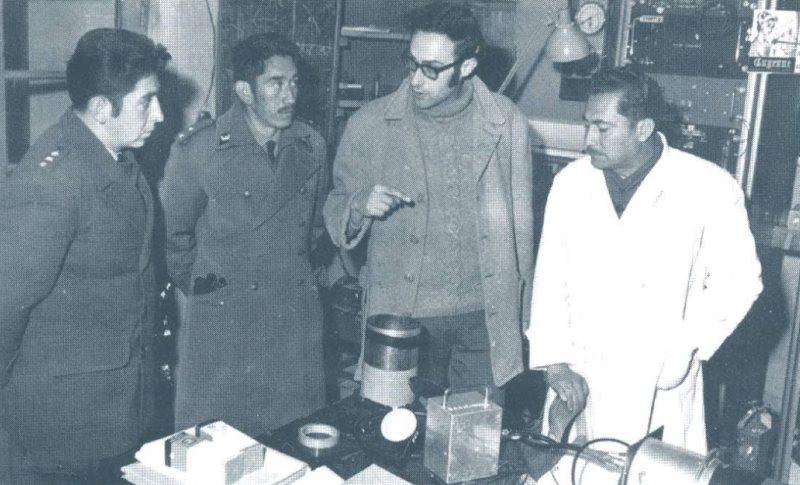
Carlos Aguirre and José Antonio Zelaya explaining to visitors, between 1973 and 1979. Much of what the Laboratory did for the country was to explain what research is for. IIF–UMSA archive.
The study-and-work scholarship programme was intense. Names that passed through it: Javier Calero, Ángel Garzón, José Alberto Ruiz, Guido and Freddy Capra, José Ipiña, José Díaz and many others.
The study group at the Facultad de Ingeniería. In his 1987 essay Schulczewski recalls the initial group of students with whom he formed a "study group of excellence": Enrique Azcui, Roger Levy Sanjinés, Adhemar Daroca, Gastón Mejía Brown, Humberto Peinado, Iván Guzmán de Rojas and José Flores.
The teachers. Schulczewski names two of exceptional quality: Prof. Raoul Weil and Ing. Juan Hersil. Aguirre adds that they made "hard work a badge of pride".
And an external endorsement. In a letter to Aguirre of 5 March 1985, John Linsley — the same man as the 1982 letter to Physics Today — wrote that on his 1982 visit he found the Chacaltaya Laboratory
"is very favourable for producing good scientists, fully 'equipped' to enter the mainstreams of science at the international level",
and added that there is ample evidence of this, as attested by the presence of Bolivian physicists at international symposia over many years.
Translation note. Linsley's 1985 letter and his text in Physics Today were written in English. They reach us only through Aguirre's Spanish translation, so the English wording given here is a restitution and must be collated with the originals before publication (see §16 and §19).
It is this milestone's specific external endorsement, and it adds to the three already in the dossier: IUPAP (1964), Linsley in Physics Today (1982) and Jones (1982).
And the documented output (Aguirre's estimate, 1952–1994):
Type
Number
Issues of Resumen de Labores
30
Monographs
78
Original contributions (papers and communications)
~600
Bachelor's, master's and doctoral theses
120
Technical reports
50
One hundred and twenty theses. That is the figure that measures this milestone.
From Laboratory to Institute
Between 1970 and 1973 the Universidad Mayor de San Andrés decided to turn the Laboratorio de Física Cósmica into the Instituto de Investigaciones Físicas (Institute of Physics Research). From September 1973 onwards, Carlos Aguirre, as director, led that transformation.
In 1976 the Institute absorbed the Instituto Geofísico Boliviano, descendant of the International Geophysical Year Committee created by decree in 1957. This is the point at which this milestone's arc closes: the institution that had helped create a state body twenty years earlier ended up incorporating it.
Aguirre adds a governance fact that the dossier should record without embellishment: in its first 26 years the Laboratory and the Institute had five directorships, "a stability that was key to its success". In the 1980s there were six. The instability did not stop until the early 1990s.
The full list of directorships is no longer an open point. The review of the Institute's archive (Moreno Rivadeneira, 16 September 2026) gives it in full, from 1952 to 2011. Two things that document brings to this milestone:
Harjit Ahluwalia appears alongside Rafael Vidaurre at the head of the Laboratory in 1963–1967. His curriculum vitae specifies the post —Scientific Director— and dates it 1965–68, funded by the IAEA (1965–1967) and by the Pan American Union (1967–1968), and further records him as National Representative of Bolivia (1966–1969) to IUPAP, COSPAR and other bodies. ⚠ The dates in the two sources do not match, probably because two distinct posts coexisted. That a United Nations body paid for the Laboratory's scientific directorship, and that the country's representation before IUPAP was exercised from that chair, belongs squarely to the argument of this milestone: Bolivia's machinery of international scientific representation also came out of this house.
Five consecutive directorships, from 1968 to 1982, are annotated in the archive as "(dictatorship)". The Laboratory sustained its scientific output and its international agreements through fourteen years of de facto governments. It is a fact to be handled carefully and without embellishment, but it speaks to the institutional continuity of the site better than any other figure, and it is precisely what a heritage dossier asks to be demonstrated.
Chronology of the milestone
Date
Event
7 June 1956
Escobar proposes to the rector's office the Instituto Nacional de Investigaciones Nucleares. Rector Aráoz suggests adding to it a Departamento de Investigaciones Matemáticas, headed by Wilhelm Damköhler.
1956
Physics Today publishes an article on the Laboratory describing it as a unique site for the study of cosmic rays.
15 August 1957
Supreme Decree 04715 (government of Hernán Siles Zuazo): the Comité Nacional del Año Geofísico is set up (official name in the Gazette). ✅
Late 1950s
Escobar, Hartmann and Muñoz Reyes travel to Knoxville; the plans for the nuclear energy commission are drawn up. Luis Barragán receives a scholarship to Brazil in nuclear medicine.
Late 1950s
Mario Guzmán builds the country's first flat-plate solar heater.
23 Sept. 1960
Supreme Decree 5582 ✅: “Créase la Academia Nacional de Ciencias, como institución rectora de la actividad estatal…”. The Laboratory's role to be established.
March 1962
The activities of the Comisión Boliviana de Energía Nuclear begin, "under the umbrella" of the Laboratory, with Escobar as first director.
1960s
The Laboratory drives the Centro de Cálculo of UMSA, the country's first computing centre (Magín Zubieta) ⚠ and the Instituto de Ciencias Básicas (Abelardo Alarcón), to which it supplies the first teaching equipment.
1966
The observation of the total solar eclipse is organised.
1970–1973 ⚠
UMSA decides to turn the Laboratory into the Instituto de Investigaciones Físicas. The Institute's archive dates the change of name to 1972; Aguirre describes it as a process carried out from September 1973.
September 1973
Carlos Aguirre takes over as director and leads the transformation. Between 1973 and 1975 he also directs the Centro de Planificación y Coordinación de la Investigación, with 17 institutes in his charge.
Late 1973
The Planetario de la Universidad is inaugurated, driven in large part by Max Schreier.
1974
The Observatorio Magnético de Seguencoma is installed with the Carnegie Institution.
6 September 1974
The Observatorio Astronómico de Patacamaya is inaugurated, under the Bolivia–USSR agreement. Rector Jorge Siles Salinas.
1976
The Instituto Geofísico Boliviano is placed under the Instituto de Investigaciones Físicas. Aguirre is given a seat in the Academia Nacional de Ciencias.
1970s
Consolidation of the Sociedad Boliviana de Física; setting up of the IUPAP National Committee, the Comisión Nacional de Estudios Geofísicos, the Comisión Nacional de Geodinámica and the Sistema Nacional de Desarrollo Científico y Tecnológico.
January 1978
Aguirre leaves the directorship of the Instituto de Investigaciones Físicas to become first Director of Science and Technology at the Ministerio de Planeamiento.
November 1978
Talks at the Leningrad Observatory that will lead to the Santa Ana de Tarija Observatory.
1980
The Santa Ana de Tarija Observatory is placed under the Academia Nacional de Ciencias.
5 March 1985
John Linsley's letter: Chacaltaya is "very favourable for producing good scientists".
Period
Director
1952–1963
Ismael Escobar Vallejo
1963–1967
Rafael Vidaurre and Harjit Ahluwalia ⚠
1967–1968
Óscar Saavedra
June 1968 – October 1973
Gastón Mejía(dictatorship)
October 1973 – 1978
Carlos Aguirre(dictatorship)
1978–1980
Ricardo Anda Peters(dictatorship)
1980
Manuel Arellano(dictatorship)
1980–1982
José Antonio Zelaya(dictatorship)
1982–1983
Nicolás Martinic
1983–1988
Óscar Villegas
1989–1992
Orlando Asturizaga
1992
Alcides Reguerín, Nicolás Martinic
1992–1995
Alfonso Velarde
1997–1999 and 1999–2002
Pedro Miranda Loza
2002–2005 and 2005–2008
Alfonso Velarde Chávez
2008–2011
Wilfredo Tavera Llanos
The documents as an element of the property
Milestones 06 and 07 have objects: a lead detector, some emulsion plates. The object of this milestone is paper, and that makes it at once more fragile and easier to recover.
What the dossier needs to assemble:
Escobar's proposal to the rector's office, 7 June 1956. The milestone's founding document.
The four supreme decrees in their Gaceta Oficial version: 1942 (national park), 2921 of 1952, 4715 of 1957 and the 1962 lead decree — plus 05725 and 5489. ✅ Those of 1942, 1952 and 1957, and 5582 of 1960, are already confirmed in the Gazette's index; the full texts remain to be obtained. Brought together and presented as a set, they are the documentary proof of continued state recognition of the site over twenty years and five governments.
**The complete run of *Resumen de Labores*** (30 issues). It is, according to Aguirre, one of the oldest scientific journals of UMSA, and in 1962 it won the Premio Nacional "Faja Verde" (National "Faja Verde" Prize).
The list of the 120 theses produced between 1952 and 1994, with authors and institutions. It is the inventory of the site's human capital, and probably this milestone's most persuasive document.
John Linsley's letter of 5 March 1985 and the essay by R. H. Schulczewski, "Chacaltaya: aportes para una historia" (La Paz, March 1987), the source of much of this milestone.
Observation. This milestone does not call for urgent physical conservation, but it does call for digitisation. A dossier that can show the decrees, the theses and the publications in a consultable digital archive demonstrates documentary integrity, which is one of the criteria UNESCO assesses.
The case for the UNESCO nomination
Short form (for the page):
Out of the Chacaltaya Laboratory came the country's nuclear energy commission, Bolivia's first computing centre, today's Facultad de Ciencias Puras y Naturales of UMSA, the degree programme in Electronic Engineering, the Instituto Geofísico Boliviano and much of the state apparatus for science policy. One hundred and twenty theses in forty years.
Developed form (for the dossier):
Cultural value, not only scientific. The other milestones argue what was discovered here. This one argues what was built in the country starting from here. It is the argument that turns the property from "a place where good physics was done" into "an institution that catalysed a state's scientific system". UNESCO's criteria value the second of these.
The chain can be documented and verified. It is not a rhetorical claim: there is a dated proposal (1956), supreme decrees (1957, 1960, 1962), institutions that exist today under other names (Facultad de Ciencias Puras y Naturales, IBTEN, the degree programmes in Electrical and Electronic Engineering) and an output figure (120 theses, ~600 contributions). Every link can be checked.
Four supreme decrees in twenty years, from different governments. 1942, 1952, 1957 and 1962. The Bolivian state returned to this place and its activity again and again, under administrations of opposing political stripes. It is proof of continuity of recognition, which is what a heritage dossier needs to demonstrate.
The transfer went beyond the field. Nuclear medicine, computing, applied geophysics, the country's magnetic cartography, hydrogeological prospecting, solar energy, metallurgy, astronomy, science policy. Cosmic-ray physics was the vehicle, not the destination.
A replicable and therefore exemplary model. The Chacaltaya case documents how a single centre of fundamental research, sustained over time, generates a national scientific system in a country of limited resources. That value as an example — for other countries in similar conditions — is an argument of universal significance, which is exactly what UNESCO requires.
And there is a specific external endorsement. John Linsley, 1985: the Laboratory is "very favourable for producing good scientists, fully equipped to enter the mainstreams of science at the international level".
Sources
Carlos Aguirre Bastos, Medio siglo de ciencia en Bolivia. El Laboratorio de Física Cósmica de Chacaltaya de la UMSA, Fundación Universitaria Simón I. Patiño, La Paz, 1996 — ch. XIII, "Nota final: el Laboratorio y el desarrollo de la ciencia en Bolivia", and the chapters on the 1950s, 1960s and 1970s.
R. H. Schulczewski, "Chacaltaya: aportes para una historia", La Paz, March 1987. Cited by Aguirre. ⚠ Full text to be located.
A. Velarde, "Instituto de Investigaciones Físicas", Memorias de la… ⚠ Reference to be completed.
Letter from John Linsley to Carlos Aguirre, 5 March 1985. Cited by Aguirre. ⚠ To be located. Originally written in English; known only through Aguirre's Spanish translation, and to be collated with the original.
Supreme Decree 04715, of 15 August 1957 (Comité Nacional del Año Geofísico). ✅ Located in the Gazette's index; full text to be obtained.
Supreme Decree 05725 (Comisión Permanente). ⚠ To be located; by its number, March 1961.
Supreme Decree 5489, of 14 January 1960 (Comisión Boliviana de Energía Nuclear) ⚠ and Supreme Decree 5582, of 23 September 1960 (Academia Nacional de Ciencias) ⚠ — dates taken from secondary online sources, pending collation with the Gaceta Oficial.
Physics Today, article on the Laboratory, 1956. ⚠ Reference to be completed.
Obituary and profiles of Iván Guzmán de Rojas (1934–2022), Bolivian press, January 2022.
How to cite this page
«1956–1976 · The Laboratory That Founded Bolivian Science». Chacaltaya Cosmic Ray Laboratory, Instituto de Investigaciones Físicas, UMSA. https://chacaltaya.umsa.bo/en/
This site is being built
The Chacaltaya Cosmic Ray Laboratory is a candidate for World Heritage status. If you hold documents, photographs or memories of the Laboratory, the project would like to hear from you.