
Twelve years separate the aluminium hut that a few students carried up by hand from the formal declaration in which the world's highest authority in physics called this mountain "essential". In between there are expeditions from ten countries, 226 pylons from a dismantled tin mine hauled 160 kilometres, roofs that blew away in a snowstorm, and eight men whose names deserve to be read slowly.
1952–1954: the world arrives
Between 1952 and 1954 expeditions arrive in Bolivia from everywhere to carry out projects on cosmic radiation: researchers from the United States, Brazil, Great Britain, Japan, India, Italy, France, Argentina and the Soviet Union, among others. Aguirre sums it up like this: an impressive group of people who, together with their Bolivian colleagues, build the modern science of cosmic radiation.
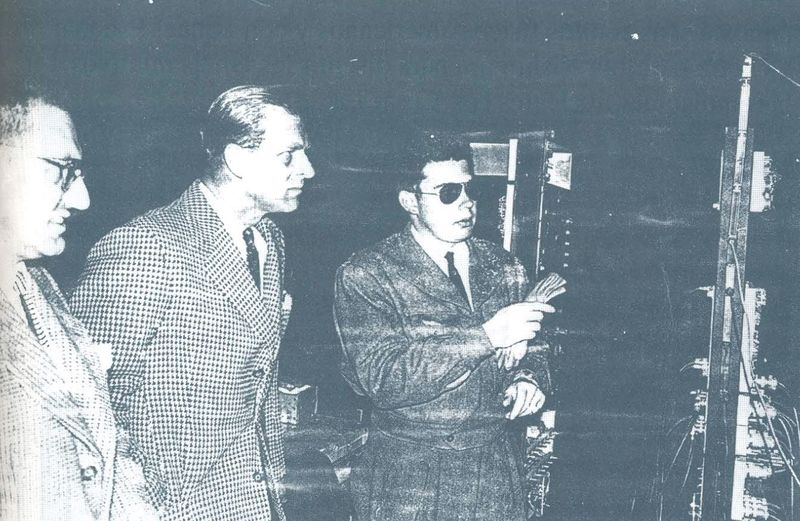
In barely two years, a mountain that in 1947 had a skiers' hut and a thermometer becomes an obligatory meeting point for an entire discipline.
The other side: 1952–1956
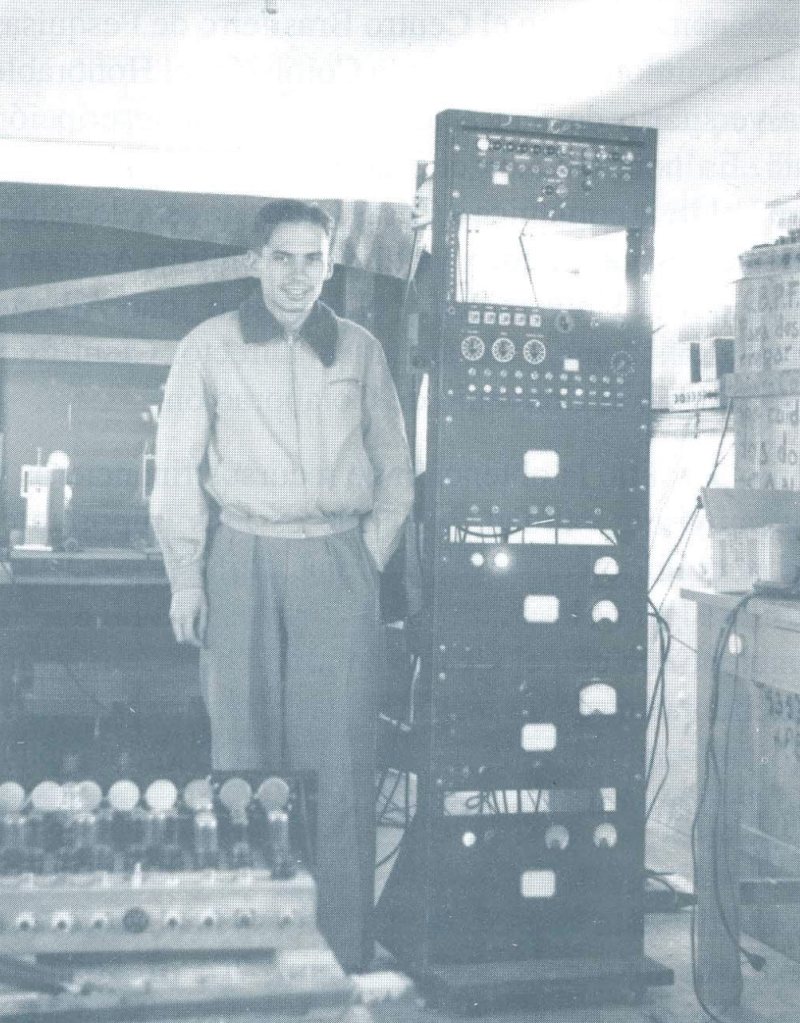
This belongs on the same page, because it is what gives the measure of the effort. The same period was extremely difficult because of the social and economic situation that followed the Revolution of 9 April 1952. Aguirre, who read the correspondence of the time, says that it was necessary to resort "almost to charity" (translated from the Spanish). Three examples that are in the archives:
- Escobar asked the Armed Forces for permission to use a military vehicle at weekends to go up the mountain. He was refused.
- A dramatic note to the Rector reporting that the roofs of the Laboratory at Chacaltaya "had flown off" during a snowstorm, and that corrugated iron sheets were needed to prevent it happening again.
- For the wiring of the electrical network, disused material was used, including a transformer from the Prefectura del Departamento de La Paz (Prefecture of the Department of La Paz).
Editorial note. This section does not weaken the dossier: it strengthens it. A site where first-rate science was done with scrap material, in a country in revolution, and which even so produced results the IUPAP called essential, is a more remarkable case — not a lesser one — than one with comfortable funding.
1954: the power line, and eight names
By 1954 the infrastructure had expanded: the La Paz office already had a substantial library and lecture rooms. And that year the power line up to Chacaltaya was completed.
The material was donated by the government of Bolivia: it was the remains of a tin mine. Laboratory staff dismantled the mine's line and transported it more than 160 kilometres. 226 pylons and more than 2,000 kilos of copper wire were put in place. The line ran first at 6 KVA and later at 36 KVA.
The interconnection with the local grid was achieved by Juan Hersil and Alfonso Lazo — Hersil would later found the Laboratorio de Electrónica (Electronics Laboratory) of the Facultad de Ingeniería (Faculty of Engineering), out of which came the degree programme in Electrical and Electronic Engineering — together with eight workers whom Aguirre took care to name:
José Monasterios · Eusebio Monasterios · Arturo López · Tiburcio Quisucala · Vicente Cabaya · Marcos Calisaya · Honorio Paco · Ceferino Quilla
These eight names should appear on the site in the same size of type as those of the Nobel laureates. It is not a gesture: it is historical accuracy. Without that power line there is no BASJE, there are no emulsion chambers, there are no sixty years of data. High-altitude physics is done by physicists and it is done by electricians, and on this mountain the latter have documented first names and surnames.
Link with the project archive. The folder of photographs of former IIF workers is the natural place to cross-check these names. If any of the eight appears identified in a photograph, it is a first-order item for the People section.
1954: two cloud chambers, and only one worked
That same year two experiments arrive which are worth telling apart carefully, because for years they were confused into a single story:
- Professor Kurt Sitte, of Syracuse University, arrives with an experiment to study extensive air showers.
- Doctors Gottlieb and Hertzler, of the University of Chicago, set up at Chacaltaya one of the site's first Wilson chambers — and this one did operate.
The other cloud chamber, the one Marcel Schein had given to Lattes to take to the Andean peak and study the then newly discovered K mesons, never worked, or worked only for a very short time. The technical reasons were never clear; Vieira and Videira point to the low atmospheric pressure of the place.
New experiments were also installed to measure the mean free path for collisions in carbon and other elements.
Logistics, which is half of physics
Doing physics at 5,200 metres in the 1950s was, above all, a transport problem. Heavy material came in through the ports of Arica (Chile) and Mollendo (Peru) and from there went up by train, lorry and jeep. For the BASJE experiment more than sixty tonnes of equipment would arrive from Japan and the United States by that route.
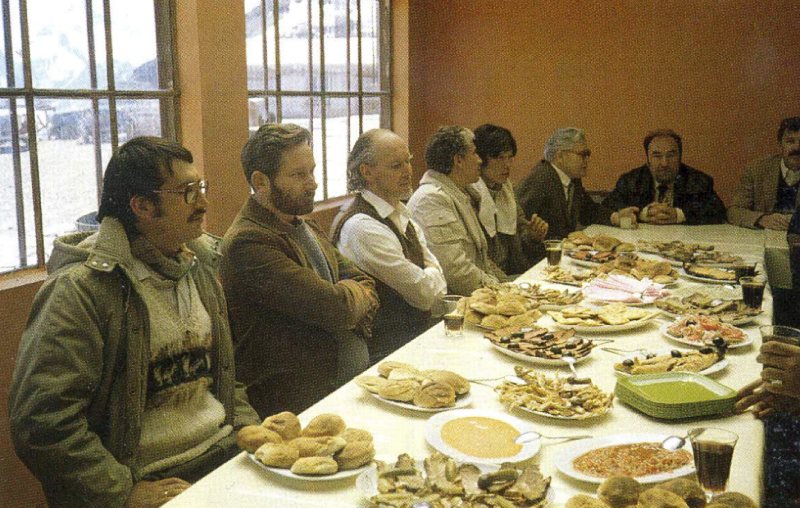
And there was a silent partner that sustained the collaboration for twenty years: until the early 1970s, the Correio Aéreo Nacional (National Air Mail Service) of the Brazilian Air Force carried personnel and equipment free of charge on its Rio de Janeiro–La Paz flights.
Publishing from the first year
The Laboratory's first results were published in June 1952 — six months after it began to exist — and since then the papers and monographs coming out of Chacaltaya have been published without interruption.
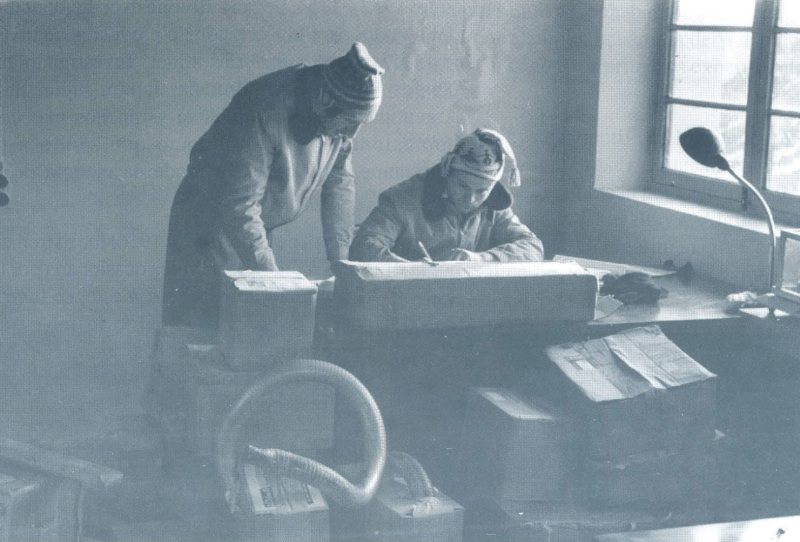
Under the title Resumen de Labores, the Laboratory presented its main work to the international community. It is one of the oldest scientific journals of the Universidad Mayor de San Andrés (UMSA). On 17 October 1962 the Resumen received the Premio Nacional "Faja Verde" (National "Green Sash" Prize) as the best scientific and technological production in Bolivia.
In the mid-1970s the University's financial difficulties made it impossible to keep up its regularity.
For the dossier: an unbroken series of publications since 1952 is direct evidence of continuity of scientific use, and it is also archivable, citable material. **Digitising the complete collection of the Resumen de Labores should be in the work plan.**
1956: Physics Today looks at the mountain
In 1956 the magazine Physics Today devoted an article to the Laboratory as a unique place in the world for the study of cosmic rays. It is the first recognition in the widely circulated international scientific press, and it comes barely four years after the foundation.
28 February 1964: the IUPAP declaration
Following the International Cosmic Ray Conference in Jaipur (India), the Cosmic Ray Commission of the International Union of Pure and Applied Physics issued this declaration:
… at the International Cosmic Ray Conference held in Jaipur, India, remarkable results were presented, based on work carried out on Mount Chacaltaya in Bolivia and at the Kolar field in India. … The IUPAP Commission considers that these two experimental sites are essential for research in this field of science …
— Cosmic Ray Commission of the IUPAP, 28 February 1964
Translation note. The declaration was originally written in English, but it reaches us only through the Spanish translation published by Aguirre (1996); the wording given here is a restitution into English and must be collated with the original document before it is quoted in the dossier. The same caution applies to John Linsley's letter in Physics Today (1982), quoted in §9, which was also originally in English.
This is the best quotation in the dossier, and it is worth understanding exactly why:
- It is formal. It is not the opinion of one scientist, but a declaration by the specialist commission of the world body of physics.
- It is dated and verifiable.
- It is contemporary with the events. It is not a retrospective assessment made to support a nomination: it was issued in 1964, sixty-two years before this dossier existed.
- It uses the word "essential". It is the closest thing to the concept of outstanding universal value that a source of the period can provide.
- It names only two sites in the world. Chacaltaya and Kolar.
1982: the second testimony
Almost twenty years later, the physicist John Linsley — one of the major names in the physics of ultra-high-energy cosmic rays — wrote to Physics Today:
The studies and research carried out by the Chacaltaya Laboratory between 1950 and 1980 have contributed to improving our knowledge of cosmic-ray physics out of all proportion to what might be expected by comparison with countries in similar conditions of development.
— John Linsley, "Panamerican Physics", Physics Today, vol. 35, no. 11, 1982
Translation note. As with the IUPAP declaration in §8, Linsley's letter was written in English but reaches us only through Aguirre's Spanish translation; the wording given here is a restitution and must be collated with the original published text before it is quoted in the dossier.
It is a testimony of a different nature from the IUPAP's, and complementary to it: it does not speak of the quality of the site but of the performance of the institution. Together they cover the two halves of the argument — the place was exceptional, and so was what was done with it.
Chronology of the milestone
| Date | Event |
|---|---|
| June 1952 | First results published, six months after the foundation. Resumen de Labores is born. |
| 1952–1954 | Expeditions from the USA, Brazil, Great Britain, Japan, India, Italy, France, Argentina and the USSR, among others. |
| 1952–1956 ⚠ | A period of great hardship after the Revolution of 9 April 1952. Military vehicle refused; roofs blown away by a storm; second-hand transformer from the Prefectura. |
| 1954 | The power line is completed: 226 pylons, more than 2,000 kg of copper, 160 km of line dismantled from a tin mine. Juan Hersil, Alfonso Lazo and eight workers. |
| 1954 | Kurt Sitte (Syracuse) installs a shower experiment. Gottlieb and Hertzler (Chicago) set up a Wilson chamber that does operate. |
| 1956 | Physics Today devotes an article to the Laboratory. |
| 17 October 1962 | Resumen de Labores receives the Premio Nacional "Faja Verde". |
| 28 February 1964 | The IUPAP Cosmic Ray Commission declares that Chacaltaya and Kolar "are essential for research in this field of science". |
| 1982 | John Linsley, in Physics Today: Chacaltaya's contribution was "out of all proportion". |
Open points
⚠ "The period 1932 and 1956". That is how the OCR read it; it is evidently 1952, from the context (the Revolution of 9 April 1952). Collate against the printed page before quoting.
⚠ **The 1956 Physics Today article. The sentence is cut off by a page break in the transcription. Locate the exact reference** — volume, number and title — before quoting it on the site. It is an item that can be requested directly from the publisher.
⚠ The IUPAP declaration. The text we have is the quotation given by Aguirre. The original document is missing: minutes or communication of the Cosmic Ray Commission, 28 February 1964. Given the weight this quotation carries in the dossier, locating the original is one of the most important tasks of the project. Likely route: the IUPAP secretariat and the archives of the International Cosmic Ray Conference of Jaipur (1963).
⚠ The eight workers. Aguirre gives the names but not the full surnames or each man's individual role. Cross-check with the folder of photographs of former workers and, if possible, trace relatives.
People of this milestone
- Juan Hersil. Achieved, with Alfonso Lazo, the electrical interconnection with the local grid. He would later found the Laboratorio de Electrónica of the Facultad de Ingeniería, the origin of the degree programme in Electrical and Electronic Engineering.
- Alfonso Lazo. Co-responsible for the electrical interconnection.
- José Monasterios, Eusebio Monasterios, Arturo López, Tiburcio Quisucala, Vicente Cabaya, Marcos Calisaya, Honorio Paco, Ceferino Quilla. The eight principal workers on the 1954 power line. An entry of their own in the People section.
- Kurt Sitte (Syracuse University). Experiment on extensive air showers, 1954.
- Gottlieb and Hertzler (University of Chicago). Set up the Wilson chamber that did work, 1954.
- Marcel Schein (1902–1960, University of Chicago). Gave Lattes the cloud chamber that never came into operation.
- Georges Schwachheim. Brazilian physicist, present at Chacaltaya during the CBPF's initial participation.
- José Antonio Zelaya. In charge in Bolivia of the University of New Mexico project.
- Alfredo Hendel. Photographed alongside Lattes during the construction of the Laboratory.
- John Linsley. Author of the 1982 testimony in Physics Today.
- Bolivian students trained at the CBPF: Magín Zubieta, Mario Bravo, Oscar Troncoso, Gustavo Pérez, Ricardo Anda and Rafael Vidaurre. Several would later be directors of the Laboratory or founders of other institutions.
The case for the UNESCO nomination
Short form (for the page):
On 28 February 1964, the world's highest authority in physics declared that only two experimental sites on the planet were "essential" for research in cosmic rays. One was Kolar, in India. The other is this mountain.
Developed form (for the dossier):
- Formal, contemporary and verifiable recognition. The IUPAP declaration of 1964 is the closest thing to a ruling on outstanding universal value that a source of the period can provide. It was not drafted to support a nomination: it precedes it by sixty-two years, and its author is the world body of the discipline.
- Demonstrated international comparability. The same declaration names Kolar (India) as the other essential site. A heritage dossier needs to place the property alongside its peers; here the comparison was not made by the candidate but by the competent authority, and it reduced the universe to two.
- Exceptional performance, not only an exceptional site. Linsley's testimony (1982) documents that the site's scientific output was disproportionate to the material conditions of the country. It is an argument of cultural value: it speaks not of a geographical advantage but of what a small group of people did with it.
- Effective universality. Between 1952 and 1954 researchers from at least nine countries on four continents climbed the mountain. The status of "essential site" was not a label: it was the description of a fact.
- Documentary continuity of the output. Resumen de Labores, published without interruption since June 1952 and awarded a prize in 1962, is the serial proof of that activity and a complete archival collection awaiting digitisation.
Sources
- Carlos Aguirre Bastos, Medio siglo de ciencia en Bolivia. El Laboratorio de Física Cósmica de Chacaltaya de la Universidad Mayor de San Andrés, Fundación Universitaria Simón I. Patiño, La Paz, 1996, ch. V.
- Cosmic Ray Commission of the International Union of Pure and Applied Physics, declaration of 28 February 1964, cited by Aguirre (1996). ⚠ Original to be located.
- John Linsley, "Panamerican Physics", Physics Today, vol. 35, no. 11, 1982.
- Physics Today, article on the Laboratory, 1956. ⚠ Exact reference to be located.
- Resumen de Labores, Chacaltaya Cosmic Ray Laboratory, from June 1952.
- A. Marques (ed.), César Lattes 70 Anos: a Nova Física Brasileira, CBPF, Rio de Janeiro, December 1994. Contains a full description of the Brazilian expeditions.
- R. H. Schulczewski, Chacaltaya: aportes para una historia, La Paz, March 1987.
- Cássio Leite Vieira and Antonio Augusto Passos Videira, "Chacaltaya: um laboratório nas nuvens", in História da Física (2019).
This site is being built
The Chacaltaya Cosmic Ray Laboratory is a candidate for World Heritage status. If you hold documents, photographs or memories of the Laboratory, the project would like to hear from you.
Get in touch